


The All-domain Anomaly Resolution Office (AARO) received 319 reports of UAP related events. Of those, 284 feature UAP-related events occurring during the reporting period.
AARO resolved 114 of the 319 UAP reports, each attributable to various prosaic objects such as balloons, birds, satellites, aircraft, UAS, and a single instance each of a rocket launch and a manned jet pack. Pending review and director authorization, AARO’s analytic team recommends the closure of three additional cases.
AARO transferred 191 of the 319 UAP cases to its active archive pending the future discovery of corroborating data sources. The active archive is a category of UAP reports with insufficient data to assess whether the performance characteristics of the underlying event are consistent with those of natural phenomena or exceed the known state-of-the-art for technological systems.
These three passages appear to suggest that there are 202 cases which remain unexplained following investigation, of which 191 are pending further information.
These three excerpts are scattered throughout the text. As the AARO is responsible for collecting and resolving UAP cases, the official wording used here is questionable. It is almost as if this specific wording was created to prevent the actual number of unexplained cases from being clearly interpreted.
The fact that 191 of these 202 cases are ‘pending the future discovery of corroborating data sources’ is similar to the approach taken by France’s GEIPAN. The number of unexplained cases can vary between 30% and 3%, depending on the scale of reliability and strangeness applied to the data.
As UAP sightings are rare, it is even rarer to have several witnesses present at the time of a sighting, let alone a data collection platform. Even if the event is exactly the same, the reliability of the witnesses is reduced by sheer luck because other cases have different witnesses and data. This does not mean that the less reliable cases did not happen, but rather that there are fewer, more reliable cases because they have multiple sources of data.
Strategic Threat
AARO received and analyzed several reports describing UAP in or near national security sites or critical infrastructure. Some narrative reports were suggestive of phenomena whose performance characteristics exceed the known state-of-the-art within a given domain. No technical data accompanied these reports. If validated, the attendant phenomena underlying these reports may represent a currently unmitigated threat vector.
One might expect the AARO, which is jointly managed by the ODNI and the Pentagon, to be the office most actively engaged in strategic issues relating to UAPs. Recent studies published by the SCU suggest that the AARO is particularly interested in these sites. However, the AARO found no supporting data during its investigation, which seems strange given that their report states that strategic US sites are over-represented in cases of suspicion because they are more closely monitored than the rest of the territory.
One might question the scope of their investigation, given that they state that ‘no technical data accompanied these reports’ without subsequently describing their own efforts. The following sentence acknowledges the prevalence of the danger, stating that if the phenomena underlying these reports are validated, they may represent an unmitigated threat vector.
AARO received 50 reports from the Administrator for Nuclear Security and Chairman of the Nuclear Regulatory Commission regarding unmanned aerial systems (UAS) incidents near U.S. nuclear infrastructure, weapons, and launch sites, a 177.8 percent increase over the 18 reported in AARO’s FY 2024 annual report. None of these incidents were reported as UAP.
Twenty-six incidents persisted for under one hour, with the shortest recorded at approximately two minutes. The other 21 incidents occurred over durations of unreported lengths. The reports contained descriptions of UAS morphologies ranging from small hobbyist-sized UAS to larger multi-rotor models. Quadcopters were the most reported morphology.
The terminology used here raises questions once again: the nuclear safety administrator has reported 50 cases of unmanned aerial system (UAS) sightings. The AARO states that these were not reported as UAPs, as they were reported as UAS... yes, indeed.
Could these cases be among those that the AARO considers to have been explained, which would skew their statistics? No classification information is provided.
Aviation Safety
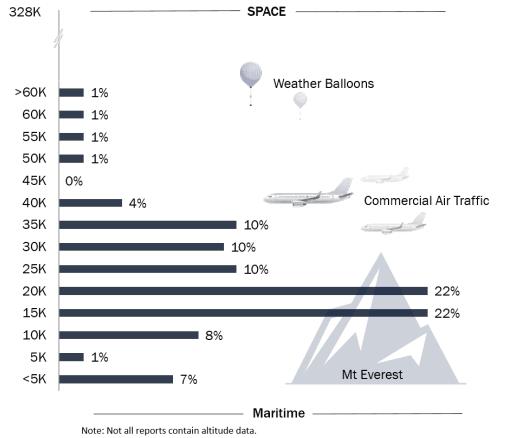
Two UAP reports described electronic or avionic interference as attributable to UAP in proximity to an operational aircraft. AARO has not yet rendered a determination on whether, and to what extent, the reported effects are attributable to UAP.
Ever since the Mantell incident in the United States in 1948, in which a fighter pilot died while pursuing a UAP, the dangers posed by these advanced platforms have been well known. This was even officially confirmed in the British Ministry of Defence’s Condign Report in 2000. Flight safety has been at the heart of the issues surrounding UAPs, as Sentinel News has reported numerous times.
It is concerning that the report raises this possibility yet the AARO, despite all its investigative resources, is unable to draw any conclusions or cite specific cases. Given the six-month delay, it cannot be said that they lacked the time to reach a conclusion.
Curiously, the same report states that ‘no reports indicated a flight safety concern during this reporting period’. One might question whether the authors read their own report.
Maritime Encounters
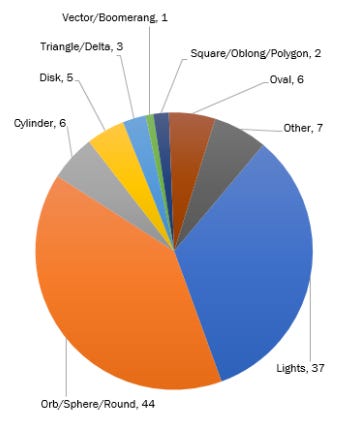
The single maritime domain UAP case AARO received involved a report from U.S. Navy assets operating off the coast of Virginia. The report described approximately 100 airborne UAP and two, likely uncrewed, surface systems. AARO is actively investigating this event in coordination with the reporting unit.
Since 2018, waves of unexplained objects emerging from the Atlantic and Pacific Oceans have made headlines on numerous occasions. However, AARO only mentions one case, off the coast of Virginia.
What about the cases of the Omaha, in New Jersey, and in Colorado? Is the US defence establishment turning a blind eye, conducting test operations involving new technologies on their own troops, or are these sightings the result of attempts at intimidation by foreign actors?