

![Pascale JACQUES [EN]'s avatar](https://substackcdn.com/image/fetch/$s_!XFlT!,w_108,h_108,c_fill,f_webp,q_auto:good,fl_progressive:steep/https%3A%2F%2Fsubstack-post-media.s3.amazonaws.com%2Fpublic%2Fimages%2Fdd2b9b08-243d-4919-b7c4-343042051752_922x922.png)
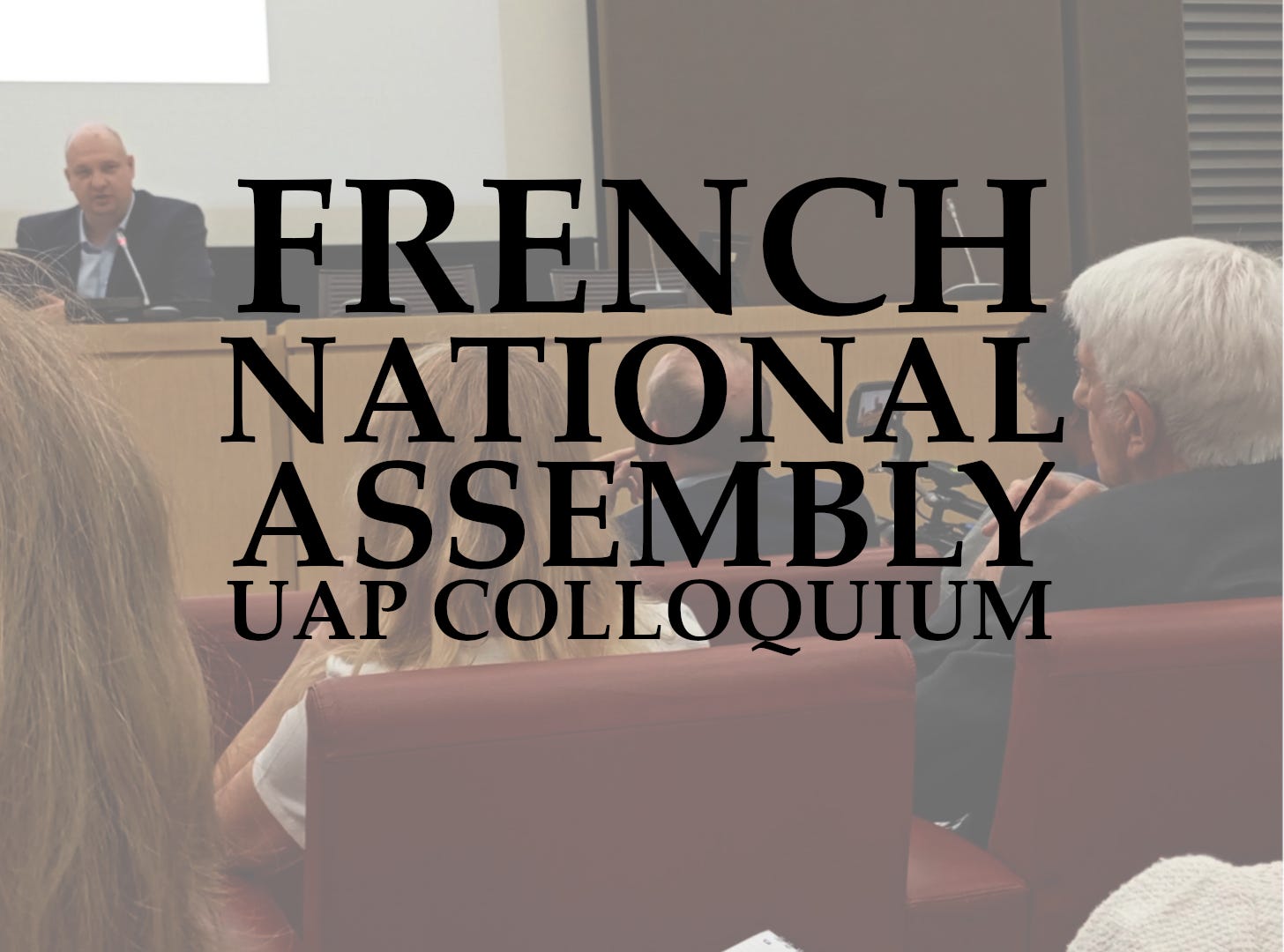
On 29 June, MPs Pierre Henriet and Arnaud Saint-Martin brought together researchers, engineers, military personnel and public officials to put France’s legacy of UAP research into perspective and highlight its significance.
As members of the Parliamentary Office for the Evaluation of Scientific and Technological Choices (OPECST), Pierre Henriet (Horizons) and Arnaud Saint-Martin (LFI) sought to give a voice to those who study the phenomenon seriously and to take stock of research into it in France.
In turn, the speakers were able to present their views and their work during three round-table discussions:
Research into UAPs: history and contemporary issues
Official work on UAPs by GEIPAN and the Air and Space Force
From GEIPAN to the Pentagon: current developments and responses from the authorities
UAPs: a matter of popular belief?
The subject is not new and continues to divide society. Pierre Lagrange, a sociologist of science and associate researcher at EHESS, has been studying the subject for over thirty years. He explains that, ever since its emergence in the United States, the subject has been framed incorrectly.
“This debate is often presented as the emergence of a popular belief, an irrational phenomenon. It is, in fact, a debate that reflects the emergence of a belief in the beliefs of others.”
In fact, Orson Welles did not cause a panic in 1938. Pierre Lagrange’s research demonstrates that this was a fabrication by the media and elites the following day.
“We always seek to isolate belief, credulity, this section of the public which is deemed irrational. Yet the real problem is our obsession – quite literally – with finding credulity and irrationality. ”
Over the last four centuries, Western society has been built on the idea of elevating itself, of distinguishing itself from so-called ‘savage’ peoples. The drive towards modernisation has led Western society to distance itself from what it considers irrational. This has shaped how the UAPs are viewed. But over time, society and science have evolved. And the debate has shifted from treating the phenomenon as a matter of popular beliefs to framing it as a conspiracy theory.
UAPs: is this issue taken seriously?
“To the question ‘Are UFOs a serious subject?’, the French government has long since responded in its own way by prioritising communication with the public without, however, neglecting the military and scientific implications.”
Jérôme Lamy
Jérôme Lamy, a sociologist at the CNRS, and Dominique Pinsolle, a historian at the University of Bordeaux, have undertaken a socio-historical study of GEIPAN (Group for the Study and Information on Unidentified Aerospace Phenomena) since January 2026.
Three key factors have emerged from this:
A civic dimension
It is important to address citizens’ concerns, which are often amplified and perpetuated by the media. Here, the uncanny is seen as a threshold of unease linked to a need for explanation;
A scientific approach
GEIPAN’s raison d’être lies in providing a response based on the scientific method, enabling a rational explanation of unknown or unusual phenomena. GEIPAN’s work follows a process of rationalisation that draws on judicial methods;
National defence
This aspect was less significant in the early 2000s but has gained increasing prominence in recent years, as demonstrated by the changing nature of media coverage of GEIPAN.
When it comes to the notion of strangeness, Jérôme Lamy points out that it is not GEIPAN’s role to generate new knowledge.
‘The various stakeholders interviewed are relatively unanimous in our survey. It is not appropriate to compare GEIPAN to a conventional research laboratory that would produce new, peer-reviewed knowledge within a scientific field governed by standards of truth-finding—such as the replication of experiments. ”
What response is given to the public?
GEIPAN is an indispensable institution in the study of UAPs. Frédéric Courtade, director of GEIPAN, was accompanied by one of the investigators, Gilles Munsch, to present the structure of this organisation as well as how it operates. Established by the CNES in 1977, the Group for the Study and Information on Unidentified Aerospace Phenomena (GEIPAN) is responsible for collecting, analysing and archiving unidentified aerospace phenomena, whilst keeping the public informed. To carry out its mission, GEIPAN relies on a team of 16 specially trained volunteer investigators, CNES’s in-house expertise, a committee of experts and various government departments.
This mission to provide information, combined with a commitment to transparency, has led GEIPAN to make public all 3,368 cases studied, of which:
28 per cent are fully identified phenomena (Case A),
38.8 per cent are probably identified phenomena (Case B),
30.1 per cent are unidentified phenomena due to a lack of data (Case C),
3.1 per cent are phenomena that remain unidentified following investigation (i.e. 106 Case D cases).
(GEIPAN statistics – 26 June 2026)
At a time when the United States is striving for greater transparency, France has had, for nearly 50 years, a structure in place for analysing reports from the public and professionals in the civil aviation sector, which draws on government services and a multidisciplinary committee of experts.
However, GEIPAN’s role is limited to case studies. When a case remains unexplained despite solid investigative evidence, it is classified as a ‘D’ case.
A member of the audience asks who determines the research activities that are intended to fill this gap in scientific and technical knowledge.
“As far as research is concerned, that falls outside my remit. GEIPAN does not carry out research. Research is entrusted to universities and the CNRS. There is no ufology programme at the CNES. It is not the CNES’s role to conduct research.”
Frédéric Courtade
The response from the Air and Space Force
This opportunity to report an observation of a strange or anomalous nature is not limited to civilians. Colonel Mathieu Courtaban, deputy director of CAPCODA, and Captain Jérémy Moyal were also present to outline the Air and Space Force’s response.
CAPCODA’s aim is to merge all radar detections—whether civilian or military—across the national territory and to establish a recognised and intelligible air situation, in order to monitor all objects flying over French airspace and, where necessary, intervene in the event of uncertainty regarding the level of threat that a particular object might pose. Consequently, CAPCODA operates on two levels:
It supports GEIPAN’s investigations by providing this available radar data;
As part of the surveillance of the national territory, and when an object presents a level of uncertainty or is unidentified, the unit may initiate a verification operation.
“Reports from our own crews account for only a small percentage of the air traffic taking place over national territory. And in my view, we are looking at fewer than one report per year from Air Force crews.”
“The modernisation of our radar network, particularly our military radar network, enables us to detect targets that are increasingly small and travelling at ever-lower speeds. This has led to a significant increase in the number of sorties by our fighter aircraft, which mostly go out to identify objects that ultimately turn out not to be threats at all, that is to say, regularly flocks of migratory birds detected at very high altitudes or a whole host of balloons, some of which – without giving away any secrets – feature Mickey or Minnie Mouse heads in eastern Paris. ”
Mathieu Courtaban points out that, in addition to civilian and military radars, CAPCODA can also rely on a satellite-based surveillance radar that enables it to detect objects in the highest layers of the atmosphere.
To the best of my knowledge, in my time at CAPCODA, we are not aware of any incidents that we have been completely unable to identify, particularly those exhibiting kinematic characteristics and changes in direction that appear, at first glance, inexplicable.
The study of ‘D’ cases
Since 2008, the 3AF (French Aeronautical and Astronautical Association) has had a committee dedicated to studying UAPs, the SIGMA2 Commission, which is responsible for the scientific and technical analysis of unexplained ‘D’ cases (according to GEIPAN terminology), whether French or foreign. This committee works in collaboration with the CNES, the Directorate General for Armament and also the civil aviation authorities.
It comprises around thirty people, covering a wide range of expertise: civil and military pilots, a rear admiral, an astronaut, a doctor, a psychologist, engineers from industry and the public sector, and specialists in electromagnetism, missiles, directed-energy weapons, air defence, and radar, optical and infrared.
According to Luc Dini, chair of the SIGMA 2 Commission:
“We are, unequivocally and clearly, dealing with physical phenomena that can be observed and recorded.”
During his presentation, Luc Dini outlined the commission’s modus operandi. To do so, he drew on a case he received from the CEFAA (Chile) in 2017. This emblematic case, observed from a Cougar helicopter, was resolved by SIGMA 2, which identified the unidentified aerial phenomenon (UAP) as an Airbus A340 with its contrail.
Luc Dini also mentioned a case dating back to 2007 in the Channel Islands, based on a pilot’s visual account corroborated by a radar track spanning several hundred metres. This case remains unsolved to this day and is still being investigated by the commission. The SIGMA 2 Commission has also examined metal samples and vegetation associated with PAN sightings.
Whatever case the SIGMA 2 Commission receives, it endeavours to characterise the observed phenomena and objects, and to determine the physical laws governing them. Rather than going into detail about Luc Dini’s presentation, we invite the reader to consult the SIGMA 2 Progress Report published in June 2021.
Luc Dini concludes his presentation with two recommendations:
We need more records to be able to explore the subject in greater depth and better characterise unidentified aerospace phenomena. One recommendation, therefore, would be to establish links between databases – particularly with the CNES database, which contains more technical data. This would also encourage pilots and air traffic controllers to provide their own accounts. Many do not dare to do so.
Observe, document, understand
The real challenge is not just that of the unexplained. It is also a challenge of observation, data collection and managing uncertainty.
Philippe Ailleris
Philippe Ailleris has been a Senior Project Controller at the European Space Agency (ESA) for 28 years. During his presentation, he emphasised the importance of improving observations and instrumentation relating to the study of the sky. The increase in aviation and space activities has led to a rise in reports across Europe. However, these phenomena remain particularly difficult to study due to their unpredictable nature and the resulting lack of available data. A scientific study cannot rely solely on eyewitness accounts or on a video taken out of context.
The more instrumental measurements we add – and the more independent sensors we use – the greater the scientific value. […] The more numerous, independent and well-documented the data are, the easier it becomes to understand what has been observed.
Philippe Ailleris concludes by emphasising the need to continue observations, improve data quality and carry on with research.
Science does not progress by accepting all hypotheses, nor by systematically rejecting them. The challenge is not to defend extraordinary conclusions but to improve our ability to study unusual phenomena with an open mind, rigour, method and a critical approach.
Improving data analysis
For Michael Vaillant, data scientist and founder of UAP Check, the creation of a scientific committee would enable a shift from passive data collection to proactive observation on the one hand, and the creation of a database that can be utilised by the scientific community on the other. Such a scientific committee would safeguard the interests of both defence and science. Michael Vaillant also proposes the creation of a European equivalent to GEIPAN. This would require standardisation of the data collected, making it more readily usable for research.
Today, every country, every organisation and every base has organised differently what they call ‘unidentified cases’, with protocols that do not align. In the United States, the ‘unknown’ takes one form; in France, it takes another; my ‘unknown’ is not necessarily your ‘unknown’. If we want to organise science on an international scale, we need to be talking about the same ‘unknown’.
France and the world: the international situation
Baptiste Friscourt, correspondent for The Debrief and founder of the territorial observation association Sentinel Center, focused more on how institutions communicate about these phenomena and on the observed impact on the public. He draws on the wave of sightings in Belgium that took place between 1989 and 1991. During this period, there were more than 2,000 sightings, sometimes with several dozen reports from civilians and law enforcement officers on a single day. F-16s were dispatched on several occasions in an attempt to intercept them. On three occasions, the pilots managed to lock onto the targets with their radar for a few seconds before the targets changed position and extremely rapid acceleration broke the lock. On 16 December 1989, the Minister of Defence, Jean-Pol Poncelet, confirmed that the so-called UFOs were in fact nothing more than lights from a nightclub reflected by the clouds. Two days later, Colonel De Brouwer, Chief of Operations for the Air Force, contradicted this version and stated that “ground operators had observed unexplained radar echoes displaying extremely variable speeds, bearing no relation to the speeds of commercial airliners or military cargo aircraft”. Beyond the evident contradiction in official communications, the Belgian wave demonstrates that, during such significant events, the public does not panic.
Baptiste Friscourt also revisited the issue of European coordination.
For several decades now, MEPs have been questioning the European Commission about UAPs. The Commission’s response is consistently the same: this falls within the national responsibility of the Member States, not the European Union. However, they are perfectly willing, for example, to use the Horizon programme to launch a research programme on the subject.
Furthermore, he points out that specific tools for pilots already exist within EASA, the European Aviation Safety Agency, but that pilots’ reports are classified as secret in all countries except Switzerland and the United Kingdom.
These reports reveal that communication and positions are often contradictory at the level of individual states and authorities. Indeed, several reports made public (Airprox, the Condign project, etc.) detail situations or recommendations concerning the safety of pilots and their aircraft. However, when Members of the House of Lords question representatives of the Ministry of Defence about UAPs, the Ministry of Defence responds that this does not constitute a matter of national defence.
Several countries communicate publicly on this subject. Spain undertook a massive declassification of military reports as early as 1991. Italy publishes an annual report on the number of objects encountered and the investigations carried out. Brazil has experienced numerous cases, some of which have been very well documented, notably by Jacques Vallée. In Uruguay, the air force has been investigating the subject since 1979. The Chilean army has had a permanent study group on the subject since 1997. China has enlisted the civilian population to help detect the phenomenon and claims to have successfully intercepted at least one object. Numerous testimonies from Russian military personnel and pilots are available from the period prior to the war in Ukraine. There is a striking similarity in the way the United States and Russia communicate on this subject. And Japan has indicated it is ready to collaborate with any other nation seeking to investigate the matter.
Baptiste Friscourt therefore raises the question of how French authorities are communicating on this subject.
This account is corroborated in the United States by Dr Mc Gwier, who, whilst on a mission aboard a nuclear submarine, observed a huge craft passing alongside the submarine and forcing it to surface. This was also confirmed by Admiral Gallaudet. As France has the second-largest exclusive economic zone, it would be interesting to ask our submariners whether they have encountered the same objects.
Echoing Mathieu Courtaban’s statements regarding reports made to CAPCODA, he states:
During my investigation for The Debrief, I was able to contact French military pilots, particularly within the naval aviation forces, who confirmed that there were sightings of these unexplained advanced platforms [at a rate of] three to four cases a year within their unit. When I asked them why they did not report the information to CAPCODA, they said the risk to their careers was too great. Civilian pilots gave me exactly the same answer. What is very interesting is that this is a perceived risk. […] When I asked them what might change the situation, they said: the fact that a member of the general staff were to state that there is a need to report these objects to higher authorities.
Finally, he points out that research programmes are already underway at universities in France and across Europe, and that others are in the pipeline at major research institutes. He adds that some programmes have the capacity to set up specific observatories to gather reliable data that meets academic standards. He cites the example of the IFEX programme at the University of Würzburg, led by Professor Hakan Kayal with the support of the army.
Is France ready?
Sylvain Maisonneuve served as a ministerial adviser for almost five years. This experience enabled him to identify four structural weaknesses in the workings of power concerning the issue of UAPs:
the holistic yet granular analysis we apply to events abroad,
our conformist mindset, which makes it difficult for us to think outside established frameworks,
our regulatory framework, which requires first to define and categorise an issue before addressing it,
the complexity of data collection.
Whilst preparing his book, *UFOs: The Declassified Investigation*, published in 2025, he explains that he approached several ministers, but none of them regarded the subject as serious, credible or worthy of study. This was not due to negligence, closed-mindedness or anything of the sort; it was simply that they did not even consider the topic themselves. However, Sylvain Maisonneuve believes that the ‘weak signals’ stage has long since been passed. This is borne out by the comments of John Brennan, Director of the CIA under Obama; Avril Haines, Director of National Intelligence under Biden; and John Ratcliffe, the current Director of the CIA. In light of the ongoing declassification in the United States, what is the status of France’s preparedness on this issue?
To build on the discussions initiated by the symposium, Sylvain Maisonneuve proposes launching a rapid-response mission. This would be a fact-finding mission lasting considerably less than the commissions of inquiry, which generally run for a period of six months. It would enable us to review our governance, our tools and our data collection processes (both civilian and military), as well as our strategic monitoring.
We must not adopt a sensationalist, doomsday or military perspective, nor should we jump the gun and start speculating on the origin and nature of the phenomenon. The priority is already to be able to characterise it, document it in order to understand it, and form our own opinion. And I believe that, in the land of Descartes, this is the best we can do.
A first step
All participants welcomed the initiative by MPs Pierre Henriet and Arnaud Saint-Martin. The latter confirmed that this symposium was indeed a first step forward on the subject.
A number of recommendations arising from this symposium will also be put forward to highlight the collaborative work that has taken place today. And I think that perhaps this initiative will inspire others.
Pierre Henriet
Notable among the audience was Jacques Vallée, whose work was unanimously praised by the 250 people present in the auditorium. He is the author of numerous books on the subject and has devoted many years to documenting and studying UFOs.
Many of the cases mentioned by the speakers have been studied and documented by him. Dominique Filhol, director of the film *Valensole 1965*, and Alexandre Sheldon-Duplaix, a naval historian, were also present. Several specialist media outlets had also made the trip.
The entire symposium has been uploaded to Arnaud Saint-Martin’s YouTube channel (videos 1, 2, 3 and 4). The media outlet Exomagazin has also posted a video of the entire symposium, complete with transcripts in several languages.