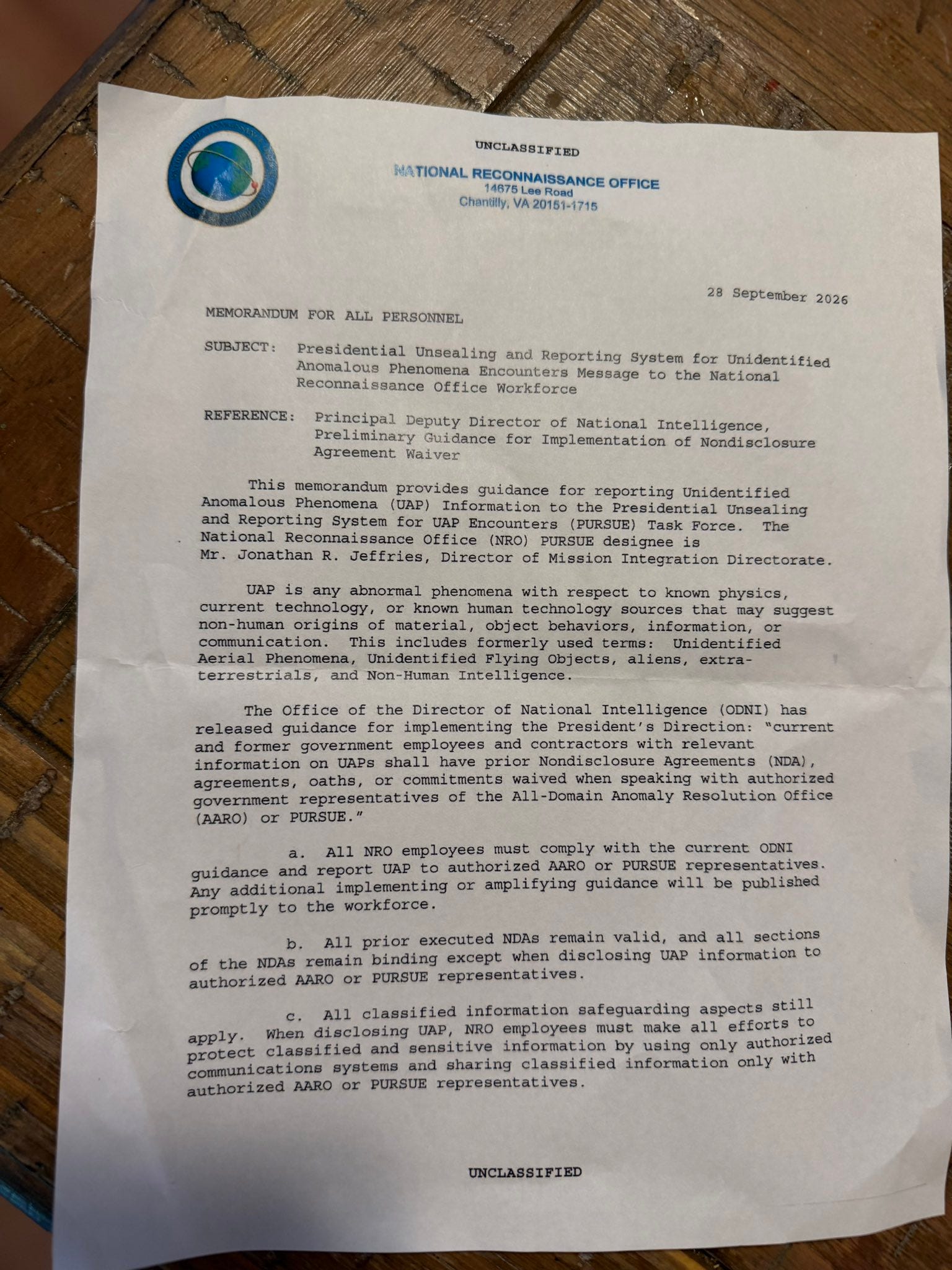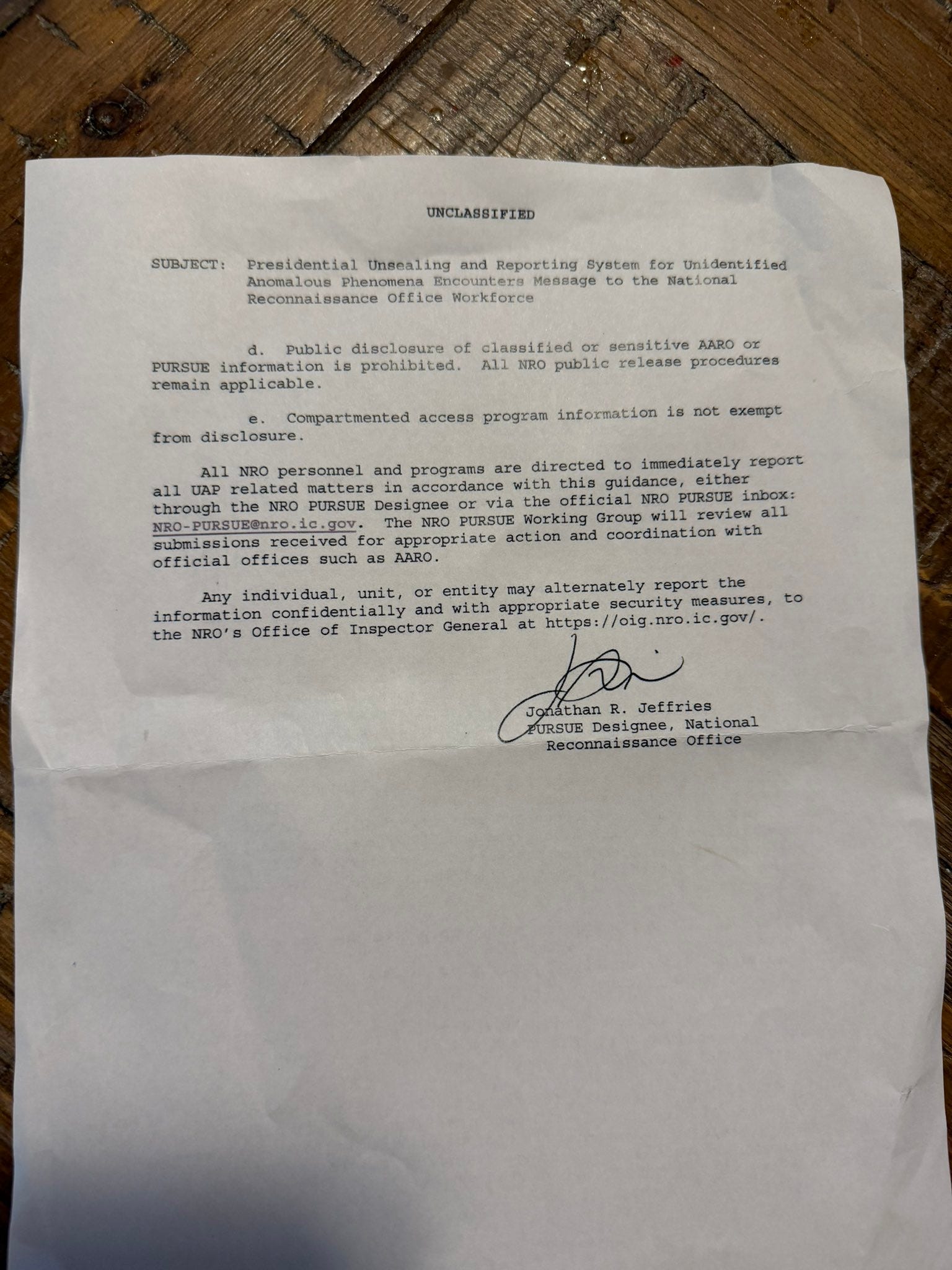
Dr Robert McGwier recently released an internal document demonstrating the genuine interest of the U.S. executive branch in the issue of UAPs.
The National Reconnaissance Office (NRO) has appointed Jonathan R. Jeffries as its PURSUE Designee, meaning he is the official responsible for overseeing the Presidential Unsealing and Reporting System for UAP Encounters programme within the agency. The unclassified memorandum, dated 28 September 2026 and signed by Jeffries, instructs all NRO personnel and programmes to report all cases relating to unidentified anomalous phenomena (UAPs) immediately.
This designation provides a name and role for the NRO’s PURSUE interface. Russ J. Jeffries, who has more than thirty years of experience in space- and airborne platforms, electronic warfare, systems design, and program acquisition and execution, is director of the Mission Integration Directorate. The NRO is a U.S. space intelligence agency responsible for developing and operating reconnaissance systems to meet national intelligence needs, among other things.
A particularly noteworthy passage is as follows:
UAP is any abnormal phenomena with respect to known physics, current technology, or known human technology sources that may suggest non-human origins of material, object behaviors, information, or communication. This includes formerly used terms: Unidentified Aerial Phenomena, Unidentified Flying Objects, aliens, extra- terrestrials, and Non-Human Intelligence.
It is extremely rare for official U.S. documents to refer directly to the term ‘extraterrestrial’, even as a hypothesis.
The memorandum establishes a specific reporting chain. Personnel must submit information regarding PANs either to the NRO’s PURSUE coordinator or to the dedicated email address. These reports are then reviewed by the PURSUE Working Group, who are responsible for determining appropriate actions and coordinating the response with the relevant offices, including the All-domain Anomaly Resolution Office (AARO).
The text also provides an alternative channel for confidential reporting to the NRO Inspector General’s Office. It reiterates that pre-existing non-disclosure agreements remain in effect, except in communications with authorised AARO or PURSUE representatives. Classified or sensitive information must be transmitted exclusively through authorised systems and must not be made public. AARO specifies that classified information must not be submitted via its public portal, but rather through secure channels.
The appointment of Jonathan R. Jeffries and the establishment of these transmission channels puts PURSUE at the centre of the NRO’s internal procedure for UAP reports. One might wonder what role the AARO will play now that the executive branch has a direct tool for declassification and data collection.