


Star-like points, recorded on old photographic plates but absent from subsequent observations: this is the starting point for two studies posted on arXiv in September 2026 by a team that includes astrophysicist Beatriz Villarroel and quantitative analysis researcher Stephen Bruehl, following their previous study, as reported by Sentinel News, and published since then in Scientific Reports.
The first, Modeling Palomar Transients: Constraints from Reflection Geometry and Orbital Altitude, published on September 4, seeks to estimate the physical properties these sources would possess if they were solar reflections produced by objects near Earth. The second, Earth-Projected Clustering of Historical Optical Transients, posted online on September 8, examines their geographic distribution. Both studies draw on a catalog of 107,875 candidates from the first Palomar photographic survey. The significance of the studied population lies in its age: the selected observations predate Sputnik, which would rule out satellites and human debris—to which many similar flashes are now attributed.
In an interview with Ross Coulthart for Reality Check, Villarroel and Bruehl present these results as successive steps in an investigation into a phenomenon that remains unexplained. Their collaboration aims to determine whether the candidates correspond solely to the imperfections expected in photographs that are several decades old, or whether some belong to a real population of light sources. The researchers cite a combination of clues: point-like images that are sometimes narrower than those of stars, clusters and alignments, a decrease in the number of candidates in the area corresponding to the Earth’s shadow, and temporal associations with nuclear tests. They also recently published a paper in Scientific Reports, where they use machine learning to clean up their sample from false detections, resulting in a stronger association with nuclear tests for higher probability transients.
Villarroel describes a relatively flat object that rotates and becomes visible only when its geometry allows for reflection. The range of sizes in the cases studied extends from centimeters to about three meters, but these figures do not necessarily reflect the size of the underlying object, which could be larger, less reflective, and have multiple surfaces.
In the interview, Villarroel presents the absence of features within the Earth’s shadow as her strongest argument against an exclusively photographic explanation: “There is no reason why features would know where the Earth’s shadow is,” she explains in essence, emphasizing the temporal dependence of the Sun–Earth geometry.
Concentrations at Nuclear Test Sites
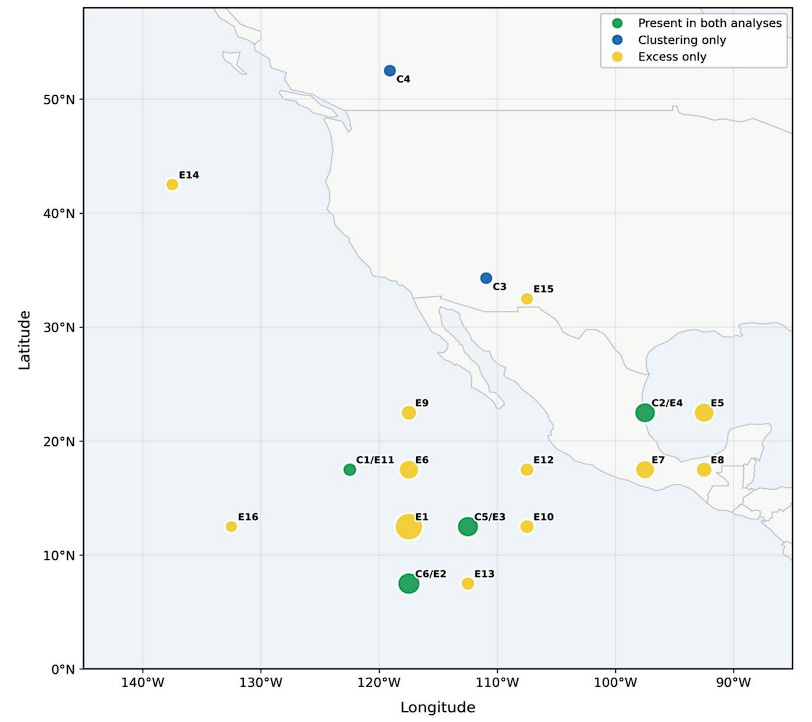
The geographical study compares the 11,418 machine learning-filtered candidates to 23,814 control locations distributed across 5-by-5-degree cells, with each control matching the time and general direction of an actual plaque. Of the 137 cells where at least five candidates are expected, sixteen show a significant excess after Bonferroni correction: nine form a cluster in the eastern Pacific, four cover part of southern Mexico and the Gulf of Mexico, and three are isolated.
The top-ranked cell has 690 candidates compared to 182.2 expected, while a cell in the Gulf region contains 258 compared to 14.4 expected; fourteen of the sixteen cells show an excess from multiple plates. A second method groups the 897 highest-scoring candidates into six clusters, four of which fall within a cell showing an excess, with no identical match for Arizona and New Mexico, whose reference centers are 377 kilometers apart.
231 candidates are observed within a one-day window before and after a nuclear test: 203, or 87.9%, are associated with Castle Yankee, the 13.5-megaton thermonuclear test on May 4, 1954, and appear the previous night in the projected regions of the eastern Pacific. The remaining 28 are linked to tests in Nevada, including 24 associated with the March 12, 1955, test, “Hornet,” with one candidate on the night of the test and 23 on the following night.
The researchers do not limit themselves to the hypothesis of an artificial origin: they examine icy fragments, natural bodies with a small reflective metallic surface, and dusty plasma phenomena in the magnetosphere. Regarding natural objects, the authors discuss the difficulty of maintaining a specular surface, the expected distributions near the ecliptic, and the possibility that a low-reflectivity body could remain invisible as a trail while producing a flash on a small facet. They find dusty plasmas difficult to reconcile with the inferred reflective surfaces, and then, among the models considered and under the assumption of a common origin, favor a scenario involving non-human intelligence capable of accounting for the various clues.
At the end of the interview, Villarroel expresses a stronger personal conviction: “I think what we’re seeing is some kind of surveillance system,” while Bruehl also supports the idea of non-human monitoring. The two scientists also link these statistical findings to UFO sightings in Sedona, White Sands, and Tampico, raising the possibility of astronomical validation of the statistical studies conducted among ground-based witnesses for over 75 years.
Both studies construct a coherent interpretation of reflections originating from sources near Earth and describe geographical concentrations as well as nuclear associations. As noted by the authors, there are other astronomical archives that could allow for further correlation of the identified statistical links, paving the way for a more comprehensive modeling of the UAP phenomenon on a global scale.