


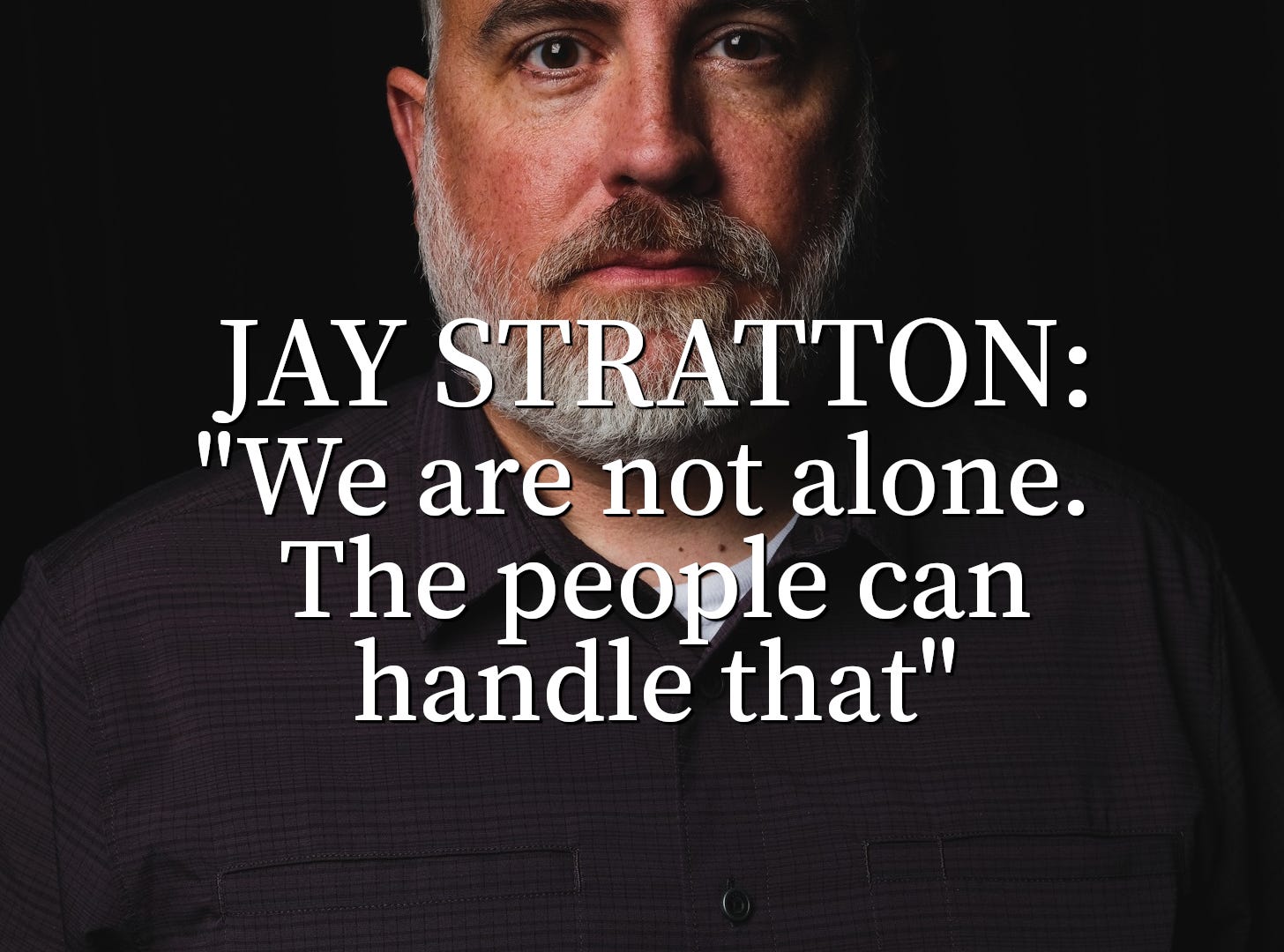
Bret Baier’s question was simple: “Are we alone?”
Jay Stratton’s answer was immediate.
“No, Bret, we’re not. Humanity is not the only intelligent life in the universe, nor do we know the intent of the non-human intelligent life that’s here. It’s very concerning.”
Speaking on Special Report ahead of the publication of his memoir, Out of the Shadows: Revealing the Truth About Non-Human Intelligent Life, the retired defense intelligence senior executive connected that statement to more than sixteen years investigating unidentified anomalous phenomena for the United States government. His account encompasses classified military imagery, encounters near nuclear facilities, intelligence reporting, and his own claimed observations of non-human craft and beings.
For Stratton, disclosure begins with a distinction: acknowledging that humanity is not alone does not require releasing every sensitive detail about the technology, the collection methods, or the government’s activities.
“I believe that there may be aspects of this that are so intense that they can’t share it, but they can share with the American people the basic fact that we are not alone. The people can handle that.”
His interview follows the path by which he says he reached that conclusion—from an unfamiliar aircraft in military airspace to a broader account of recovered technology, institutional secrecy, and unanswered questions about intent.
The Intelligence Official Behind the Statement
John “Jay” F. Stratton Jr. retired from the Office of Naval Intelligence as a defense intelligence senior executive after more than thirty-two years of military and federal service. He was the first director of the Unidentified Aerial Phenomena Task Force, an interagency organization tasked with standardizing the collection and reporting of UAP sightings.
His service included operations associated with the Gulf War, the Balkans, Iraq, and Afghanistan. Within the intelligence community, he worked on scientific and technical intelligence, all-source analysis, and congressional briefings. He also served as Naval Intelligence’s senior representative in the creation of the Certified Defense All-Source Analyst program.
In his conversation with Baier, Stratton described joining the Army in 1989 and eventually progressing into the senior executive ranks.
“I never thought joining the Army in 1989 that I would be chasing UAP and working this topic.”
At the Defense Intelligence Agency, he served as chief of air and space warfare in the Defense Warning Office, specializing in emerging and disruptive aerospace technologies. His UAP work subsequently included involvement with the Advanced Aerospace Weapon System Applications Program, or AAWSAP, and the UAP Task Force (UAPTF).
Stratton has previously emphasized that this was not a childhood fascination carried into government employment. In an earlier interview reported by KLAS, he explained:
“I didn’t really have a passion growing up. I didn’t have all the books, I didn’t watch all the TV shows, I stepped into a job at the Defense Intelligence Agency where some things came across the desk.”
Those things became the starting point for an investigation that would occupy a substantial portion of his career.
The Video That Changed the Assignment
Asked how he knew humanity was not alone, Stratton took Baier back to his DIA position and the access that accompanied it.
“In that role, I was responsible for emerging and disruptive threats, and also I had access to our most classified programs. I understood where our technology is and where our technology is going, and I also understood the technology levels of the adversaries.”
Then, he said, a colleague brought him a video of a triangular UAP flying over a nuclear missile silo.
“It was flying in ways that I could not comprehend at the time. It was flying in ways demonstrating capabilities that exceeded ours.”
Baier read a description from Stratton’s book:
“A black triangle aircraft, no wings, no tail, no exhaust, no visible propulsion of any kind, as if the fundamental laws of physics simply didn’t apply.”
The encounter, as Stratton described it, presented two immediate intelligence questions: what technology could account for the aircraft’s behavior, and who possessed it?
“I needed to understand this technology and I needed to understand who had it.”
He characterized the object as a threat because of its capabilities, its location, and the absence of information about its origin or purpose.
“This is a threat because it exceeds our capabilities and we don’t understand it, we don’t know the intent, and we don’t know where it’s from.”
The nuclear-site video occupies a foundational place in his account. It was not, he said, an unexplained image considered in isolation from his professional responsibilities. It appeared while he was working to understand advanced aerospace capabilities and potential threats to the United States.
The Files, Images, and Reports Behind the Investigation
Stratton’s public account extends beyond that first video to a body of military reporting and classified briefing material.
Earlier KLAS reporting described a comprehensive classified briefing he assembled using UAP video and photographs collected by the military. According to that report, most of the images remained unreleased, while some photographs associated with East Coast encounters and activity around Navy ships on the West Coast had become public through leaks.
The same reporting identified Stratton as the author of an investigative report on the November 2004 encounter involving the USS Nimitz carrier group and the object widely known as the “Tic Tac.”
Stratton and DIA colleague James Lacatski initially assumed that an existing office must already be examining reports of unfamiliar craft. Their attempt to locate it became part of the impetus for establishing a dedicated effort.
“As we tried to find that office, we found nothing,” Stratton told KLAS.
His description of the classified material also explains a recurring frustration in his public remarks: the difference between what an investigator has access to and what can be discussed outside government.
“It’s frustrating because you know the rest of the story and you can’t tell the rest of the story.”
In the Baier interview, Stratton described the imagery that initiated his investigation, the operational information his teams collected, and the encounters and recovered-craft descriptions covered in his memoir.
“It covers UAP cases over US military bases that haven’t been discussed yet. It gives you descriptions and details of recovered craft.”
“With My Own Eyes”
Baier moved from the origins of the investigation to the question of physical possession.
“Does the United States government have non-human craft in its possession?”
“Yes, it does.”
The next question was whether Stratton had personally seen one.
“I have seen non-human beings and non-human craft with my own eyes.”
When Baier asked him to confirm that his statement included beings, Stratton replied:
“Yes, sir.”
The exchange expanded on a declaration Stratton had already made in The Age of Disclosure, the documentary directed by Dan Farah.
“I have seen, with my own eyes, non-human craft and non-human beings.”
In the television interview, Stratton also described the custody of the craft as extending beyond government facilities.
“Both the defense contractor community and the government have craft of non-human origin.”
He said there was an ongoing effort to capture and reverse engineer the technology, characterizing the competition surrounding it as “a secret Cold War race.”
The interview did not name the contractors or locations involved. Stratton’s emphasis was on the existence of the activity and the strategic importance he assigns to it: understanding technology that he believes surpasses known human capabilities.
A Nuclear Submarine as Bait
One of the most unusual operational accounts concerned an attempt to draw a UAP into an area where military assets could collect information.
Baier quoted a passage from the memoir:
“Our bait would be a nuclear submarine. Draw a UAP in close enough to monitor, track, and if possible, capture or recover.”
Stratton said the operation emerged from several efforts to obtain better information. Eventually, he gained access to a nuclear submarine that could be deployed off the East Coast, alongside a Navy P-3 aircraft equipped for submarine hunting.
“I parked it out there to try and capture information, data on this UAP.”
Asked what happened, he answered:
“And it worked. On their very first mission, a UAP appeared.”
According to Stratton, the P-3 collected data during that mission. He did not say in the interview that the operation resulted in the capture or recovery of a craft.
The Encounter That Never Became an Intelligence Report
Stratton also recalled a telephone call from two admirals and a commander serving as their senior intelligence officer. They reported multiple UAP encounters, including an object above a training building associated with Top Gun.
“Jay, we’ve seen it with our own eyes.”
He said the witnesses described the object as appearing to “phase in” over the building before disappearing just as quickly.
For Stratton, the next step was to formally document what they had seen.
“In order to really understand that information, I need to get it into the intelligence record, so I had to get them debriefed.”
But he said that when the officers arrived at the Pentagon, another officer senior to them intervened.
“Someone who I believe is involved in this legacy program, this historic coverup, the hidden hand as I call it in the book, intercepted them and convinced them that their reputations are on the line if they make this report, and they didn’t make the report.”
Nuclear Weapons and an Ongoing Question
The nuclear connection returned when Baier played an excerpt from The Age of Disclosure. In it, Stratton described repeated activity over restricted nuclear facilities.
“We’ve had repeated instances of something operating in the airspace over restricted nuclear facilities, and it’s not ours.”
He went further, saying:
“They have both deactivated and activated nuclear weapons with both the United States and Russia.”
Stratton presented the activity as a continuing concern rather than a closed historical subject.
“The UAP activity surrounding nuclear weapons is not a historic issue. It’s an ongoing issue.”
Asked whether the beings were hostile, he did not offer a definitive answer.
“Bret, we don’t know the intent.”
He added:
“Sad for me to say after sixteen-plus years of looking at this for the government and, you know, twenty-plus years of looking at it, we do not know the intent.”
Congress, the President, and the Struggle Over Access
Stratton rejected the suggestion that publishing a memoir replaced the responsibility to brief elected officials. He said he had repeatedly taken the subject to Congress, beginning with Senator Harry Reid in 2007.
“I was one of the first to brief Congress on this topic in the modern era in 2007 when I briefed Senator Harry Reid, and I continued that through the rest of the next sixteen years till I left the government, retired.”
The book, he explained, serves a different purpose:
“It puts everything in context, and it brings it together.”
His concerns about access extend to the presidency. Asked whether President Trump had seen all the relevant evidence, Stratton answered:
“No, Bret, I don’t think he’s seen it. I think he’s still being shielded from the truth.”
He framed reaching the president as a necessary step toward a public acknowledgment.
“We have to work hard to bring the truth to the president because the president that goes to the microphone to tell the world we’re not alone, that’s a monumental moment.”
In an earlier announcement of the memoir, Stratton described his intention to disclose the information available to him within legal boundaries:
“In the book, I break my silence to reveal everything I legally can about my investigations of UAP and non-human intelligent life on behalf of the U.S. government and the profound impact my work had on me and my family.”
The Race to Understand the Technology
The final stakes Stratton outlined were geopolitical.
Asked whether China was attempting to master the technology, he included both China and Russia:
“I think China and Russia are both working on reverse engineering craft of non-human origin.”
His concern is that secrecy and restricted access could leave the United States at a disadvantage in the competition he describes. When Baier raised the disagreement between Stratton’s statements and the conclusions of the Pentagon’s UAP office, Stratton answered:
“Somebody’s wrong, and I think that America’s gonna pay the price if the truth doesn’t win in this situation. The world deserves the truth.”
Full transcript :
RFK 00:01
This group, uh, approached me to talk about UAPs.
Luna 00:06
Oh, really?
RFK 00:06
Yeah. And they, it was a very high level NASA scientist and then a bunch of Navy SEALs and Green Berets who had been on recovery teams.
Luna 00:18
Crash retrieval programs?
RFK 00:19
To g- right.
Luna 00:20
Mm-hmm.
RFK 00:20
And, you know, they, some of the stuff they talked about was crazy, about how they were, actually had figured out how to call some of the, uh, ships in and, and, you know, um, and then, uh, were under orders to destroy them and recover them.
Bret Baier 00:39
That was the Health and Human Services secretary speaking in a recent podcast about meeting with and talking to US military and senior officials involved in hunting down UAPs. Questions about unidentified anomalous phenomena, or UAPs, continue to spark massive interest from the public. For more insight on these unexplained encounters and reports of non-human life forms, I spoke with retired defense intelligence senior executive Jay Jay Stratton, who has spent more than 15 years investigating UAPs for the US government. We began our conversation on Capitol Hill, where Jay Stratton was one of the first people to brief lawmakers on this topic. Jay, you served in the US military, national intelligence, 30, almost 33 years.
Jay Stratton 01:29
Yes, sir.
Bret Baier 01:29
Long time.
Jay Stratton 01:30
Long time, long career.
Bret Baier 01:32
And you ended up the highest civilian rank.
Jay Stratton 01:35
Yes. I, I moved up from, uh, the regular GS ranks to the senior executive service, which is the highest a civilian can get non-appointed. So it’s a career move and it’s really a boost for, I guess, a statement of my capability over the years in, in that I accomplished what I did and I moved, moved the needle a little bit, enough to get recognized.
Bret Baier 01:56
But I mean, you served on battlefields and you served in the Pentagon. You served in the national intelligence community.
Jay Stratton 02:03
You know, I, I never thought joining the Army i- in 1989, that I would be chasing UAP and working this topic. It’s a, it’s a amazing career to have. Almost 33 years. Uh, over 16 of those were investigating UAP and non-human intelligent life on behalf of the US government. I, I really feel like it’s been a monumental shift in the culture. Look at that thing, dude.
Bret Baier 02:29
The Pentagon has begun declassifying and releasing records about UAPs on a rolling basis now. This follows recent directives from President Trump. Jay Jay Stratton was a central figure in the government’s investigation into these sightings and encounters. His new book is called Out of the Shadows: Revealing the Truth about Non-Human Intelligent Life. It comes out tomorrow. Why’d you write this book?
Jay Stratton 02:54
This book is very important to me. I wanted to get the word out to the people. I, I’ve been working behind the scenes for the last 20 years, uh, to get us where we’re at today in this disclosure movement. So it’s very important that people understand the, the, the main point is that the world deserves to know the truth about the UAP topic and the presence of non-human intelligent life.
Bret Baier 03:18
I’ve read it. It’s a page-turner. There’s a lot in there that I haven’t heard before. Uh, you led the government’s hunt for this for 16 years. Simple question. Are we alone?
Jay Stratton 03:32
No, Bret, we’re not. Humanity is not the only intelligent life in the universe, nor do we know the intent of the non-human intelligent life that’s here. It’s very concerning.
Bret Baier 03:42
So you say that, but how do you know?
Jay Stratton 03:45
Bret, let me take you back to where it started. I was at the Defense Intelligence Agency as the chief of air and space warfare. In that role, I was responsible for emerging and disruptive threats, and also I had access to our most classified programs. I understood where our technology is and where our technology is going, and I also understood the technology levels of the adversaries. And it was during that period that a colleague brought to me a video of a triangular UAP flying over a nuclear missile silo, some of our most secure airspace, and it was flying in ways that I could not comprehend at the time. It was, it was flying in ways demonstrating capabilities that exceeded ours.
Bret Baier 04:26
Well, let me read that part from the book. Quote, “A black triangle aircraft, no wings, no tail, no exhaust, no visible propulsion of any kind, as if the fundamental laws of physics simply didn’t apply.” Take me to that day in your life. Som- somebody hands you that video taken near this nuclear weapon storage site and, and what do you see? What do you do?
Jay Stratton 04:49
Well, it’s very telling, because in that position with the Defense Intelligence Agency, I was uniquely qualified to, to identify anything flying in the airspace. So when I’m watching something as an airspace engineer that’s demonstrating capabilities that I don’t understand and can’t comprehend, that was eye-opening and moving for me. I needed to understand this technology and I needed to understand who had it.
Bret Baier 05:11
And you considered it a, a threat?
Jay Stratton 05:13
Absolutely, Bret. This is a threat because it exceeds our capabilities and we don’t understand it, we don’t know the intent, and we don’t know where it’s from.
Bret Baier 05:20
Well, let me just cut to the chase. Does the United States government have non-human craft in its possession?
Jay Stratton 05:26
Yes, it does.
Bret Baier 05:28
And have you seen one with your eyes?
Jay Stratton 05:32
I, I have seen, uh, non-human beings and y- non-human craft with my own eyes. Uh-
Bret Baier 05:38
Non-human beings too?
Jay Stratton 05:40
Yes, sir.
Bret Baier 05:41
Where are these craft now? I- are they being reverse engineered? Does the government have them? Is it private companies that have them? What, what, where, where is this stuff?
Jay Stratton 05:51
Bret, both the defense contractor community and the government have craft of non-human origin. There is an ongoing program to-
Jay Stratton 06:00
Capture and reverse engineer this technology, and really we’re in a secret Cold War race to do that.
Bret Baier 06:06
Why haven’t we heard about this? Why, you know, all of these releases from the government, we have these videos, and some of them are very compelling-
Jay Stratton 06:15
Yeah
Bret Baier 06:15
... others not s- so much. And people say, “Well, I wanna see the real stuff.” Why haven’t we seen the real stuff?
Jay Stratton 06:23
Well, the people who have had this 80-year monopoly on the topic believe that the secret is so intense that the American people cannot handle it. I believe that there may be aspects of this that are so intense that they can’t share it, but they can share with the American people the basic fact that we are not alone. The people can handle that.
Bret Baier 06:41
In the book, you write this, “Our bait would be a nuclear submarine. Draw a UE- AP in close enough to monitor, track, and if possible, capture or recover.” So basically you used a US nuclear submarine as bait. Explain that.
Jay Stratton 06:57
I worked on several, uh, efforts to do this, and it culminated when I had access to a nuclear submarine that I could put out, uh, off the East Coast, and I had a, a P-3, uh, a Navy submarine hunting with, with a lot of different equipment on it, and I parked it out there to try and capture information, data on these, on this UAP.
Bret Baier 07:16
What happened?
Jay Stratton 07:17
And it worked. Uh, on their very first mission, a UAP appeared and the P-3 worked to, to collect on the, and data was collected on that, on that mission.
Bret Baier 07:26
You write in the book, “We’ve had four UAP encounters in the past week.” This is from two flag officers. There’s something else.
Jay Stratton 07:31
Oh, yes.
Bret Baier 07:31
Two flag officers and a commander witnessed a UAP hovering over one of our facilities. That was the call you got from, from Top Gun.
Jay Stratton 07:39
Yes, Bret. I got a phone call from two flag officers, two, two different admirals, and a commander who was their senior intelligence officer. And they said, “Jay, we’ve seen it with our own eyes.” So these, these guys are the cream of the crop, and they saw a UAP phase in, was their own words, over the training building on, on the compound, and it just disappeared as fast as it was there. Then the, the rest of the story, or the more important part of the story is, in order to really understand that information, I need to get it into the intelligence record, so I had to get them debriefed. They came to the Pentagon and a senior officer, someone senior to them, someone who I believe is involved in this legacy program, this historic coverup, the, the hidden hand as I call it in the book, intercepted them and convinced them that their reputations are on the line if they make this report, and they didn’t make the report.
Bret Baier 08:32
Is that why we haven’t seen more of this? You write in the book, “These people don’t play games, Jay.” Uh, somebody talking to you, a friend. “They’ve done worse than threaten people to keep their secrets. They’ll do it again.” A friend pulls you into his office, tells you this. What does he mean, does worse than threaten?
Jay Stratton 08:50
Throughout history, Bret, uh, the secrets sometimes are so impactful to our national security that steps have been taken to remove the problem.
Bret Baier 09:04
And the people.
Jay Stratton 09:05
And the people.
Bret Baier 09:06
When I first saw you, you were in, um, the, the documentary Age of Disclosure. Um, and here’s a clip from that, and it raised my eyebrows about Secretary Rubio as well.
Jay Stratton 09:18
We’ve had repeated instances of something operating in the airspace over restricted nuclear facilities, and it’s not ours. They have both deactivated and activated nuclear weapons with both the United States and Russia. These are otherworldly things that are performing maneuvers that have, haven’t been seen. The UAP activity surrounding nuclear weapons is not a historic issue. It’s an ongoing issue.
Bret Baier 09:43
In this book, you go farther than even the documentary went. You’ve been advising the White House since the president ordered the files released. You think he’s seen all the real evidence? Do you think he’s in the brief?
Jay Stratton 09:55
No, Bret, I don’t think he’s seen it. I think he’s still being shielded from the, the truth, and, and we have to work hard to bring the truth to the president because the president that goes to the microphone to tell the world we’re not alone, that’s a monumental moment.
Bret Baier 10:10
If an adversary cracks this technology before we do, what happens? Do you think China is trying?
Jay Stratton 10:17
I do. I think China and Russia, uh, are, are both working on reverse engineering craft of non-human origin.
Bret Baier 10:23
The Pentagon’s own UFO office says it found no evidence of extraterrestrials. You say that they’re here. Somebody’s wrong.
Jay Stratton 10:31
Somebody’s wrong, and I think that America’s gonna pay the price if, if the truth doesn’t win in this situation. The world deserves the truth.
Bret Baier 10:41
Critics say, if this is real, why put it in a book that you’re selling? Why not say to Capitol Hill, “I’m here. This is what I know. Let’s talk about this.”
Jay Stratton 10:51
Well, I’ve briefed Congress numerous times. I was one of the first to brief Congress on this topic in the modern era in 2007 when I briefed Senator Harry Reid, and I continued that through the rest of the next, uh, 16 years, uh, till I left the government, retired. The book, it, it puts everything in context, and it, and it brings it together. It’s evergreen. It covers UAP cases over US military bases that haven’t been discussed yet. It gives you descriptions and details of recovered craft. Yeah, yeah.
Bret Baier 11:18
But, you know, everybody’s asking here-
Jay Stratton 11:19
Yeah, yeah
Bret Baier 11:20
... are they hostile? What-
Jay Stratton 11:21
Ah. Bret, we don’t know the intent. Sad for me to say after 16-plus years of looking at this for the government and, you know, 20-plus years of looking at it, we do not know the intent.
Bret Baier 11:31
Well, Jay, we appreciate you talking to us today.
Jay Stratton 11:33
Thank you, sir.
Bret Baier 11:34
Thank you.
Jay Stratton 11:34
I appreciate you having me here.