


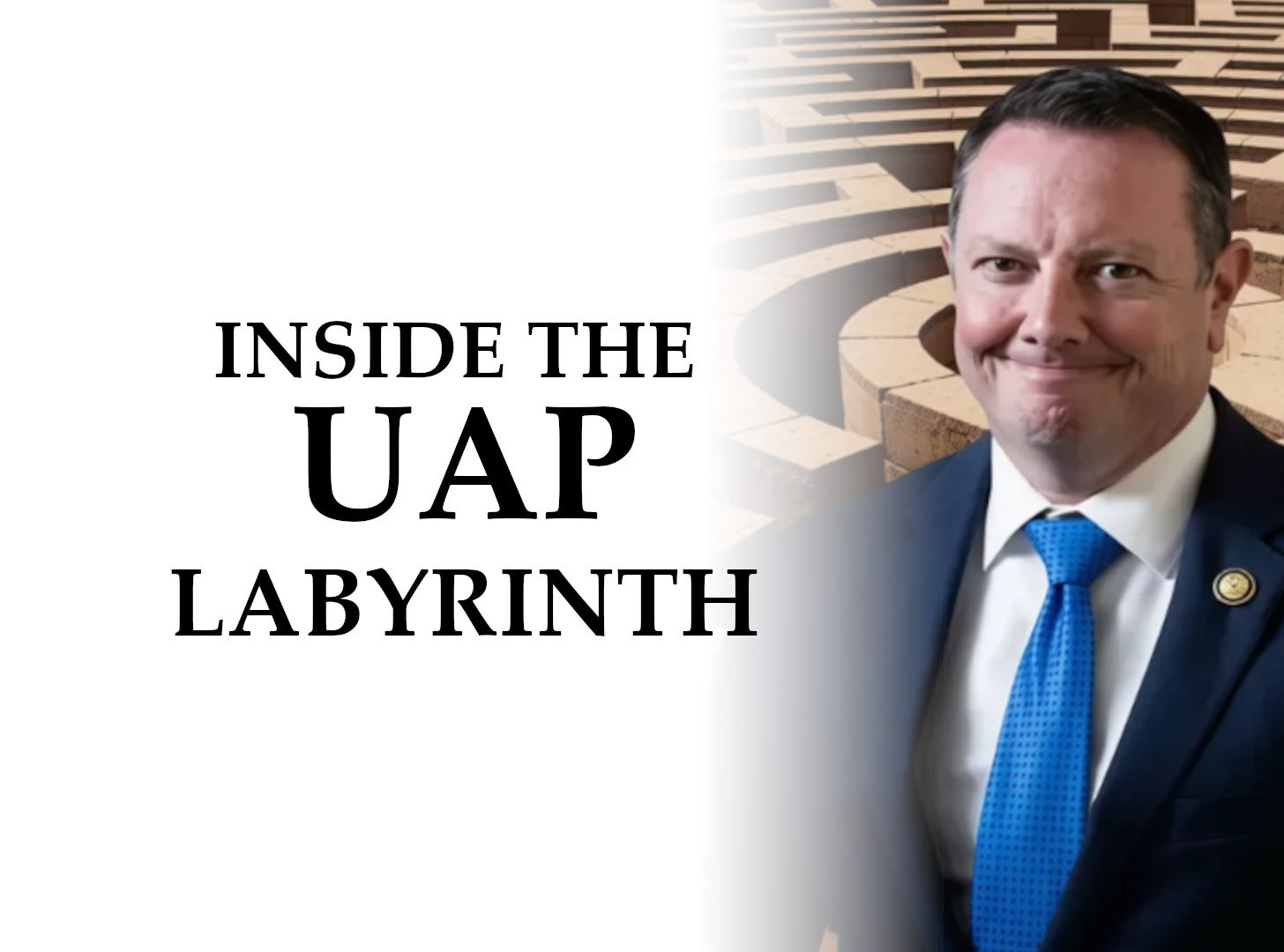
It is said that the main obstacle to disclosure is not only military, but also energy-related. Those involved in the case complain of institutional pressure, some of which has had dramatic consequences. A Missouri congressman was permitted to view recordings that neither he nor the intelligence services can explain, and he is one of a handful of elected representatives to have been given this opportunity. The legislative process is underway, but is moving slowly with obstacles at every stage. The issue of UAPs is becoming less marginalised. Thanks to representatives such as Luna and Burlison, it is no longer being ignored.
Through a selection of interviews summarised for you, you can gain an insider’s perspective on the state of affairs in the US.
Rep. Eric Burlison
The representative for Missouri’s 7th District has emerged as one of the most vocal advocates in Congress for transparency regarding Unidentified Aerial Phenomena (UAP). He has demonstrated his commitment by officially appointing David Grusch, a former senior intelligence officer and UAP whistleblower, as a special advisor for transparency efforts related to the House Oversight Working Group on the Declassification of Federal Secrets in March 2025.
Then, in August 2025, Burlison introduced the UAP Disclosure Act of 2025 as an amendment to the National Defense Authorization Act (NDAA) for the 2026 fiscal year. “For too long, Americans have been kept in the dark about UAPs,” he stated. ‘This amendment ensures these records are preserved, reviewed, and responsibly released to the public.’ During a hearing of the House Oversight Committee, Burlison presented a video of a military drone attempting to shoot down a luminous ‘orb’ off the coast of Yemen and questioned an Air Force veteran about evidence of extraterrestrial technology. He takes a pragmatic and objective approach: while he does not take a firm stance on the phenomenon’s possible non-human origin, he does not rule it out either. Above all, he focuses on verifying the testimonies of whistleblowers.
The Fresh Freedom Podcast
In the latest episode, Burlison welcomes Sam “Gerb” (also known as UAP Gerb) to discuss the institutional barriers to disclosure, including the role of the Department of Energy, administrative red tape and the need for transparency.
Obama, Trump and Disclosure
The conversation stems from a recent statement by Barack Obama, who suggested that if information on UFOs was being withheld, it might be because it was being withheld from the president himself. Presenter Nate Lucas uses this to pose the question that opens the debate.
Nate Lucas : Do you see what I’m saying, that when he said ‘unless there’s an enormous conspiracy hiding it from the president,’ and when you dig into all of these different agencies that seem to have some tie to something UFO or UAP related, maybe there’s this massive network where each agency knows a little bit, but not one single person knows everything. Could that perhaps be what he was alluding to there?
Burlison : And I’ve been requesting that. I’ve been talking to White House staff about making that request since Trump stepped into office and just saying this is something he, you know, he ran on disclosure. He did some executive orders on disclosure. One was the JFK files. The other one was MLK files. And we did not see the UAP files. And I kept asking and asking and I’m glad. I guess we could thank Obama for kind of prompting it.
Sam “Gerb” agrees and immediately puts the issue into a broader context, recalling the case of John Podesta (an American politician and former campaign manager for Hillary Clinton).
Gerb : “I think that’s exactly what he was alluding to. I also think that there have been several presidents who, during their tenure in the presidency, weren’t informed on these programs, and either towards the tail end of their presidency or following their administration, received a partial briefing. I mean, look at Barack Obama’s campaign manager, John Podesta. His name is all over the WikiLeaks files, talking about various UAP meetings with Hillary Clinton and so forth, Tom DeLonge (musician and co-founder of To the Stars Academy) , the now missing general McCasland (aerospace engineer, retired Major General of the US Air Force and former commander of the Air Force Research Laboratory) and so forth.
The JFK Files as a precedent
When asked about a president’s actual ability to declassify documents by executive order, Burlison cites the JFK Files as an initial encouraging sign.
Burlison : “We’ve had tremendous success because there is an executive order and Tulsi Gabbard has acted on that executive order. I think a lot of it has to do with who you put in charge and what kind of moral character they have. And when Trump issued that executive order, she went in and demanded that the CIA release their files. But what it does prove is that the CIA at least tried to cover up their relationship with Oswald. They had connections to him. They definitely knew who he was. They definitely were tracking him. And all of those files have come out, and the CIA tried to hold those and squash those for decades. So we’ve made some success, quite a bit of success.”
The Department of Energy at the heart of the system
Sam “Gerb” then outlines the various US classification systems and their complexity. He gives the example of the Atomic Energy Act, which has been in place since 1954 and establishes what is known as ‘restricted data’ – an automatic classification for anything related to nuclear matters. Consequently, the Department of Energy can classify anything with even the slightest connection to these matters, regardless of any presidential decree.
Burlison : It is extremely challenging and just navigating it has been nearly impossible, which is why we hired David Grusch as a part-time employee in the office, really just as even a consultant to tell us which rocks to pick up.
Gerb : If there’s any infrastructure that can house and make such technology secret, it would indeed be the Department of Energy. From what I understand with the UAP Retrieval and Exploitation Programs, the Department of Energy is baked in at every level, not just because of the classification systems, but also because there’s elements of the DOE and its semi-autonomous subordinate agency, the NNSA, the National Nuclear Security Administration, that a lot of people don’t know about.
I’m sure quite a few people don’t know that DOE has its own intelligence agency, the OICI, Office of Intelligence and Counterintelligence. The DOE has its own transportation unit that conceivably would be perfect to transit UAP materials across the continental United States. It’s called the OST, the Office of Secure Transportation. Not only that, but the DOE and NNSA have their own FFRDCs, Federally Funded Research and Development Centers. These are the national labs we all know, Sandia, Los Alamos, Lawrence Livermore, Oak Ridge on the Y-12 complex.
A history of disclosure in the 1990s
Gerb places the debate in a historical context, emphasising that investigative efforts are nothing new.
Gerb : “I think back to Dick D’Amato, who was a high level staff for the Senate in the mid-90s. He actually visited some infamous locations. I believe he went to Area 51 to try and study this topic and was given the consolation tour to show random things.
I also think back to New Mexico State Representative J. Andrew Kissner, who almost operated as a proto David Grusch. Kistner in the early 90s started to interview numerous firsthand individuals within these programs from then Air Force Major Command, Air Force Systems Command, the Office of Naval Research, the Research and Development Board, and so forth.
That actually launched Stephen Schiff’s investigation into Roswell with the General Accounting Office, when the Air Force supposedly lost all the Roswell files.
Gerb then describes the AARO as a ‘honeypot for valuable UAP information’, a trap designed to capture valuable information on UAPs and whistleblowers, and suggests that attention should be turned to the USDI and Ronald Moultrie, who helped found the AARO.
Burlison’s investigation
Nate Lucas : When you have dug into this issue, it’s probably been a little bit of a mixed bag with these agencies working with you, maybe giving you a crumb here, crumb there, leading you along, but how’s your overall experience been?
Burlison : “It was difficult at first. It’s gotten easier over time. And I think that my approach, and being consistent, I think that they realize that they can’t just continue to ignore me. But also that I tell them all the time, I’m trying to do this because I love the country. And I want to protect this country. And I think that it’s important that we be transparent to the American people on the things we should be transparent about. And then the things that really threaten our national security, I’m all for protecting as well.
I’ve been given access to go visit a site, multiple sites potentially. I’ve already visited one, I plan to visit at least three more. And, you know, I might be given the dog and pony show and taken to the cafeteria or whatever, but at least I’m able to do my part and try to do everything I can to get to these locations and see what’s there. And we have more and more whistleblowers coming to us all the time. So I think that this is starting to unravel. I really do.
Energy: the crux of the mystery
The presenter then raises the most mind-boggling aspect of the subject: if these objects can operate without visible fuel, hover indefinitely, and accelerate without generating heat, the technology they use could transform the global economy.
Nate Lucas : That would mean that they’re using an energy system that is fundamentally different from anything publicly known. There are some people who legitimately think that our advanced technology is... That’s what’s being hidden.
Burlison :Yes. And that our advanced technology is like 30 years in advance of what we know to be real or most up-to-date.
What Burlison saw with his own eyes
Nate Lucas : What’s the most compelling piece of testimony? I know some things you cannot disclose because they’re classified, but just curious if there’s anything you know or that you’ve heard that you could make the case to the American people.
Burlison : I have seen videos of objects. I can’t tell you exactly what they are. And I say that because I don’t, I’m saying I saw it and I can’t tell what they are. And neither could the people that filmed them. But it’s something that’s wild. Very, very, you know, defies logic, the way in which they operate. What you’re often seeing is these glowing type orbs. They look like balls of plasma that seem to be stationary. And then sometimes they’ll just move at incredible speeds. So I don’t know what that is. And I don’t think that our intelligence community knows what these things are.
Blackmail, intimidation and the protection of whistleblowers
Nate Lucas : Do either of you buy into the idea that one of the reasons we can’t get total disclosure is because of these blackmail networks in which people continuously hold positions and it’s used against them to keep information from getting out?²
Gerb : Well, I certainly think so. The figureheads of these programs are not a president. It’s not elected officials. It’s individuals who are not temporary employees, unelected officials. I think of senior executive service within the US armed forces, and these individuals can stay within their positions for an indefinite period.
So the keepers of the secrets, if you will, can remain in power without leaving and can also bully and intimidate others from releasing information or whistleblowing on topics. I have personally spoken to individuals who have had their pensions threatened by expressing interest in the topic.
Some other individuals have claimed that they have been threatened with very explicit content crimes if they were to go forward with some of their knowledge about the UAP programs. So it seems like there is a very large intimidation and bullying structure used to prevent people from speaking on this.
Burlison : Yeah, we have the UAP Disclosure Act and within that is whistleblower protection language. Hopefully we’ll be able to get it in the base text of the National Defense Authorization Act before it leaves the committee. That’s my goal. And so then the only way to get it out would be to strip it out and have an amendment. And I just don’t see Democrats voting to do that.
And I think most Republicans would not support that either. So I think if we can get it in, I think it’ll stay. The question is, will the Senate let it stay in? And so what we’ve seen is that there’s some senators, early Senate offices that seem to be adverse to letting other committees or other people in on their turf. And which is sad because oftentimes up here it’s a turf war.
He adds, regarding the bipartisan nature of the issue:
I’ve just got in a briefing today on this topic in a SCIF with Democrats and Republicans who came because they were all interested in this topic. It is probably one of the most bipartisan topics that’s up here.
Out of the shadows
A few days after the podcast was released, the story reached a new media milestone. On 30 March, Burlison appeared on Fox News as part of a panel discussion with three presenters. The tone of the conversation shifted, moving beyond classification and bureaucratic red tape. Names were mentioned, suspicious deaths were discussed and the crushing pressure on individuals was highlighted. Until then, the UAP dossier had been confined to specialist circles and congressional hearings, but it entered the mainstream public debate.
The interview focused on three themes: the troubling fate of individuals associated with the case, the true nature of the observed technology, and the extent and reasons behind government secrecy.
Disturbing fates
Burlison began on a sombre note. The case of General McCasland alone illustrates the pressure being exerted on those involved in this matter. He also mentioned Monica Reza, who had worked on a government-funded project concerning a superalloy used in rockets under McCasland’s supervision. She disappeared while out hiking, and the circumstances surrounding her disappearance remain unexplained. However, it is yet another case that is capturing Congress’s attention even more.
I’ve heard of others. We’ve already sent a letter when I first came in. I heard of another gentleman, and I’ll keep that name out of respect, sent a letter to the FBI investigating the suspicious suicide of another individual who had worked alongside other whistleblowers like David Grusch and Jake Barber who had come forward. So their colleague has mysteriously committed suicide. We’ve already sent the letter to the FBI to investigate that, and that is an ongoing investigation.
Reporter: I watched a documentary called Age of Disclosure. Those that have seen it know that those that are whistleblowers and talking about UFO activity, alien activity, they know that they are fearful of retaliation, retribution, whatever, for disclosing alien activity. So how much of this are you concerned, it could be not the aliens themselves doing this, but somebody who possibly wants to shut people up?
Burlison :That’s my concern as well. Look, let’s set the alien from another planet topic aside. There’s clearly demonstrated technology that is extremely advanced. And I’ve seen videos, we’ve had a lot of reports, we’ve had pilots that have encountered these objects. There is a type of technology that is so cutting edge and advanced, whether it’s being held by a foreign entity or a private contractor in the United States. What’s clear is that there’s a lot of work to keep very highly guarded the secret of that technology. And so, probably a lot of work that’s being done by our adversaries to try to discover what this technology is.
The files, the cameras and Burlison’s list
The third presenter raises two points. The first is the case of Monica Reza, a scientist whose patent on a superalloy led to a $4.7 billion deal before she went missing. The second is the statement by Christopher Mellon, a former Under Secretary of Defence under the Clinton and Bush administrations. He told the press that the federal government is said to hold a staggering number of photos and videos of UFOs. Why hide them?
Burlison : I don’t know why they’ve been keeping it a secret for so long. A lot of these videos that they’re keeping classified have been captured on technology that we don’t want our adversaries to know that we have the ability to capture. So in other words, the cameras themselves are highly classified. And because of that, we don’t want to release the footage.
Now, that doesn’t mean that Congress shouldn’t be able to see this, which is why I’ve submitted an official request to Tulsi Gabbard’s office, to the Department of War, to the Secretary of State and the Department of Energy to be able to see these files. And I’ve got a list of about two to three dozen of these files. I’ve got contact with other whistleblowers. There’s more files to come. We’ve got people on the inside watching to see based on our request, if these files have been moved, if they are deleted or changed in any way to avoid that. So we’re on the trail and hopefully Congress can be able to at least get our eyes on these videos and give some insights to the American people.
Beyond Politics
When asked about the potential significance of these findings, a presenter asks whether Burlison thinks there might be more to it than meets the eye.
Burlison : That’s what we’re looking into. I’m trying to figure out what is going on. What is actually flying in our airspace? What’s going over some of our military bases or some of our missile silos locations? There’s a lot of activity that’s reported and documented. And it’s important that we identify and figure out what’s going on.
What I’ve made very clear is that if I uncover the fact that we are not alone in this universe, that’s not something for any politician, any government to withhold from humanity. That is not top secret and it shouldn’t be top secret. But any kind of advanced technology that keeps us safe is probably something we should guard and protect.
Despite their different formats, these two interviews point in the same direction and help to highlight some clear themes.
Essentially, Burlison and Gerb are asking a simple question: who owns the information? While the Department of Energy can classify information at will, the AARO can detain whistleblowers without accountability and senators can oppose the UAP Disclosure Act, the answer remains the same as it always has been: it belongs to no one and everyone except the public.
Resistance to disclosure exerts real pressure on real people. Suspicious suicides, unexplained disappearances, forced retirements and overt intimidation: what Burlison and Gerb describe is not an abstract theory; it is a list of individuals who have been sent letters to the FBI.
Burlison himself has seen things. Not evidence of aliens, but inexplicable videos and objects that neither he nor the intelligence services can explain. He is no longer just an elected representative relaying testimonies; he is a first-hand witness.
Finally, we can gauge the scale of the legislative work currently underway. The UAP Disclosure Act exists, official requests have been sent and people within the system are monitoring whether files are being moved. The machinery is in motion. Perhaps what has changed is simply this: an elected representative continues to knock on doors, site after site, refusal after refusal, and he is now doing so live on Fox News. The obstruction may well remain systematic, but it is no longer silent.
A few weeks earlier, on the UAP Summit podcast, Representative Burlison gave a slightly more technical interview, in which he addressed other, more down-to-earth but equally compelling topics.
Before whistleblowers and bureaucratic red tape, there is a simpler, almost mechanical reality. The United States lacks the means to detect what it claims not to see.
We have built a system that is mostly designed around identifying foreign adversaries, planes and jets, things that are missile systems, things that we would know, and everything that we have has been built around that. Unfortunately, UAP is not one of those things that we have built things around.
The Chinese balloon case is less of an anomaly and more of a demonstration. They had not been spotted because nobody was looking for a balloon. The same structural blind spot applies to what the UAP community has been observing for decades: it is not merely a secret deliberately kept under wraps, but a reality that the US surveillance apparatus was simply not configured to detect.
Critical Infrastructure
The detection problem takes on a whole new dimension when plotted on a map. Reports of incursions are not concentrated in empty areas: they occur regularly over nuclear sites, military bases and underground natural gas storage facilities.
They have a deep level of concern, which is why, I think that what technology we do have in place that’s monitoring is located in those places, but we have much more that we can do.
L’aveu est précis : les agences concernées reconnaissent en interne une menace réelle. Ce qui leur manque, c’est la capacité d’y répondre, voire même de décrire précisément ce qu’elles voient.
Aviation safety: Ryan Graves and near-misses
Ryan Graves’s testimony to the House Oversight Committee highlighted an issue that military and commercial pilots had been raising for years, but without an official channel through which to do so. Burlison draws a direct conclusion from this regarding air traffic safety.
There was a grave concern that there were near miss events with objects that they could not identify that were over the military base. I have myself seen a video... one plane is landing, it’s filming another plane across the horizon, and you see three objects go at incredible speeds passing in between these two planes. Those objects have not been identified, but that’s extremely disturbing when you see something like that.
The FAA has no formal mechanism through which commercial pilots can report UAPs. Instead, their observations are referred to civil organisations that lack the authority and resources to act on them. This results in lost data building up and witnesses remaining silent for fear of professional repercussions.
The turf war
Whereas the Department of Energy imposes restrictions through classification, the Department of Homeland Security is simply absent by default.
“What I’ve learned about the federal government in the three short years I’ve been in Congress is that it’s all about territories and turf.”
The Pentagon has taken control of the UAP dossier. Despite being the US department that has released the most UAP videos and being responsible for protecting domestic airspace, borders, critical infrastructure and civil aviation security, the DHS has never been invited to the table. Special access programmes are not shared between agencies.
Burlison suggests that the Executive Office for Unmanned Aerial Systems, which already exists within the DHS, could be tasked with this mission. However, this would require congressional authorisation and a dedicated budget.
Sputnik
If the threat comes from China or Russia, the situation changes completely. Burlison puts forward this hypothesis quite bluntly.
If we were to verify that what’s happening in our airspace is a Chinese technology that is capable of doing things that we’re not capable of, that would be a Sputnik level crisis that we would have to address. And so, one has to wonder : is this non-human intelligence?
The wording is deliberate. The choice presented is not between the known and the unknown: it is between strategic humiliation at the hands of a human adversary, and something that human intelligence cannot explain. Both options are equally unsettling, for different reasons.
The legislative process
The UAP Disclosure Act, modelled on the legislation that led to the release of the JFK archives, faces an obstacle that, Burlison notes, is unusual for a subject receiving so little media attention.
You have to get the four corners of the House Armed Services Committee and the Senate counterpart, the four corners of the intelligence committee and the Senate counterpart, and the Homeland Security committee and its counterpart. It becomes extremely complicated.
The process involves three committees across both chambers. At least twelve people are involved, any one of whom has the power to block the process. During the previous session, the amendment was not approved by the House Rules Committee and was not included in the NDAA in the Senate. This was due to a lack of time, not votes. However, Burlison has succeeded in making the committee chairs recognise the issue.
You’ve opened up the door for the conversation now, and we are all kind of aware of the topic. Going forward, you have a much better chance.
Lawyer Danny Sheehan has since reviewed the text. The wording has been clarified. The clause on eminent domain remains in the draft, slightly reworded.
The 2019 drone incident
The winter of 2019–2020 was a symbolic moment. For several weeks, large drones, flying in formation at night over Nebraska and eastern Colorado, overwhelmed local emergency services. Dozens of sheriffs and their deputies witnessed this first-hand. The FBI, the DOD and the FAA launched investigations. Then the drones disappeared, and the phones in Washington stopped ringing.
When this wave stopped, it was as if the telephone in DC just went dead. They were receiving no more responses from DOD and the FBI.
The duration of this episode is almost exactly the same as that of the Langley incursions. In 2026, the relevant agencies publicly treated the waves of drones as a new phenomenon. Burlison then asks the obvious question: if it isn’t new, why is it being presented as such?
Trump
Burlison’s final argument is more political than institutional, and perhaps the most perceptive of all. There are allies within the executive branch, such as Gabbard, Rubio and Vance. However, the political will must ultimately come from the president. According to Burlison, the president possesses a quality that his predecessors did not.
I don’t think we’ve ever had a better opportunity than now to have a president that doesn’t owe the intelligence agencies a damn thing. And really, if the American people want it, I think that he would make it a priority.
The strategy is clear: ensure the issue receives sufficient media coverage to bring it to the attention of a president who responds to public pressure by nature. Taking advantage of this flexibility in the interests of freedom of information seems to be the way forward.