



The study of abductions (close encounters of the fourth kind) has always been a grey area within UFO research. Many researchers have worked and continue to work on this subject, but few consider the convergence of its two aspects, with the notable exceptions of Drs Jacques Vallée and John Mack. The latter was one of the first to attempt to study the phenomenon of close encounters, despite facing opposition from Harvard University. However, extraordinary cases like these have been found throughout history. Whether they fall within the scope of a study of the human psyche or of extraterrestrial contact, they cannot simply be dismissed, even when their absurd nature — also studied by Vallée — might lead one to ostracise them. Readers may refer to the FREE study for further information.
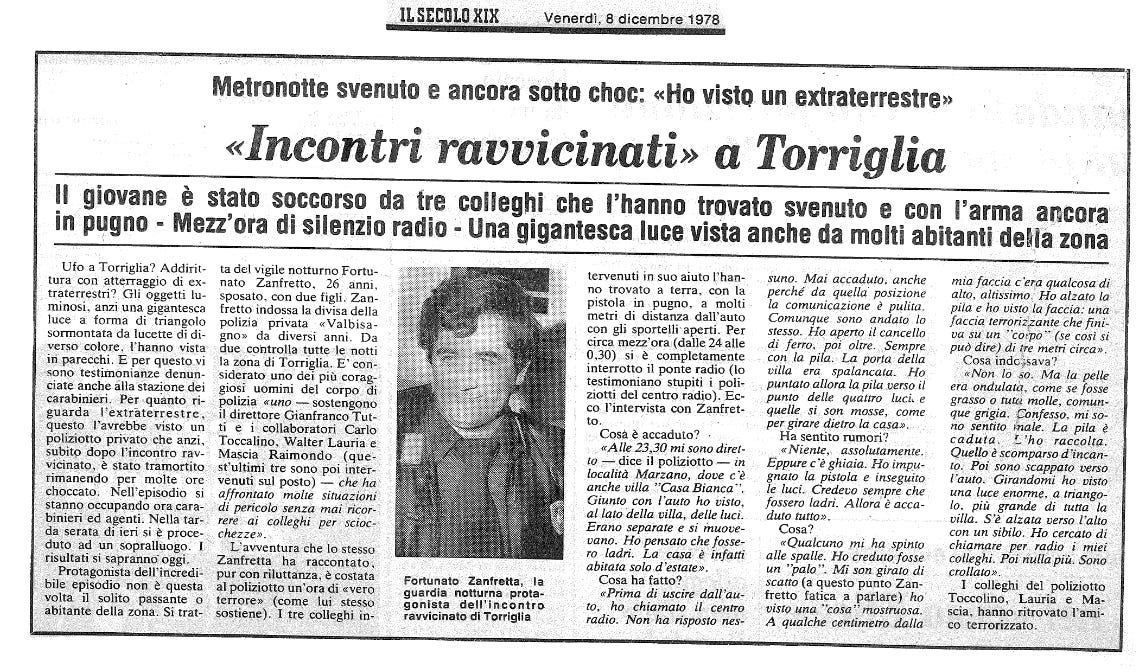
In December 1978, Pier Fortunato Zanfretta, a 26-year-old night watchman from Torriglia in the province of Genoa – contrary to what the name might suggest – is said to have experienced a series of events that left him, his colleagues and the newspapers of the time utterly baffled. These events were accompanied by a fair share of controversy, exploitation, distortion and exaggeration, depending on the interests of various parties. This occurred against the backdrop of an unprecedented wave of sightings, with interest in the subject reaching its peak.
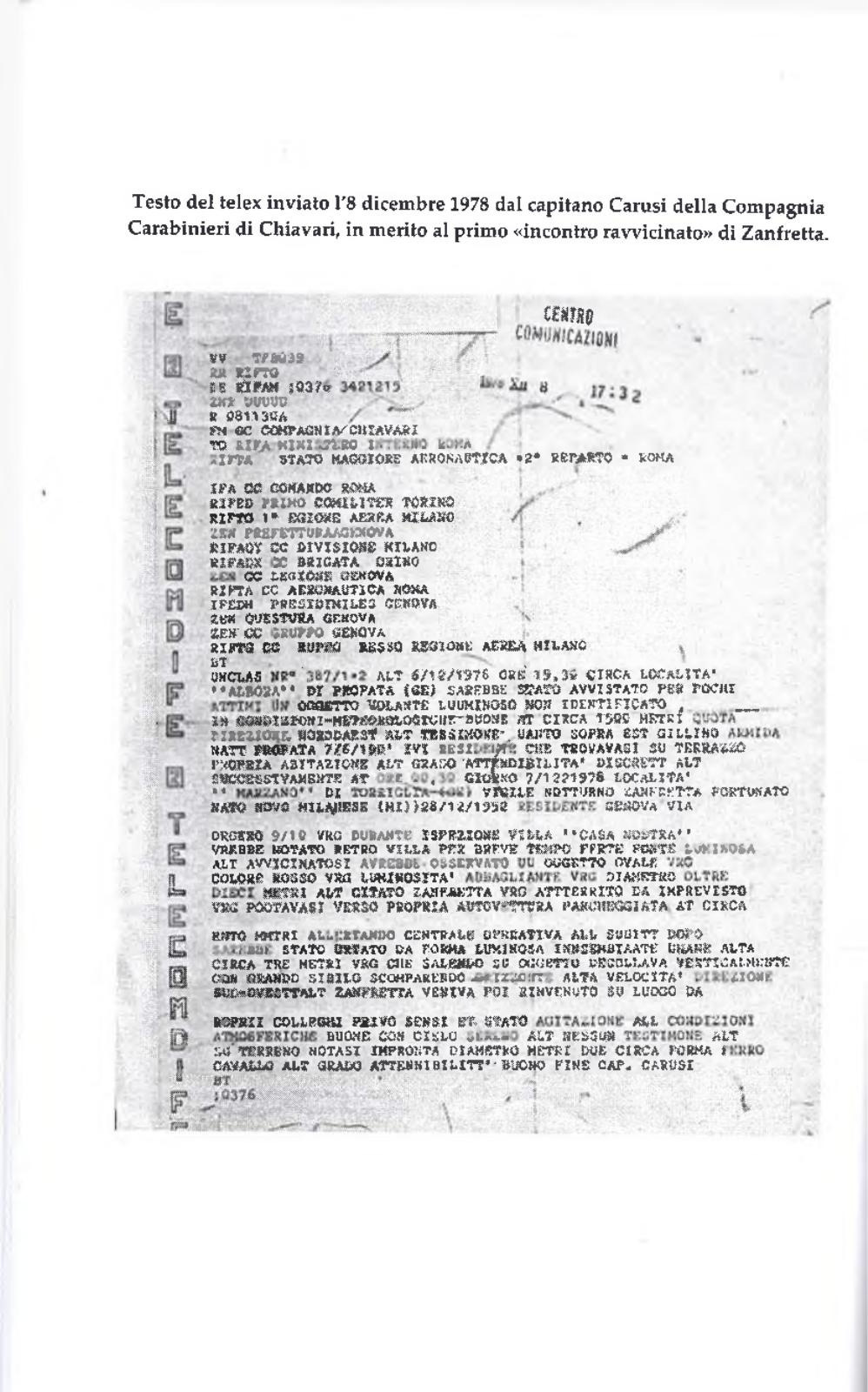
6 December 1978 — Marzano di Torriglia
Zanfretta, a night watchman at the Val Bisagno Institute in Genoa, was found unconscious in the field adjacent to the ‘Casa Nostra’ villa in Marzano di Torriglia. In a state of panic, he claimed to have seen “an enormous creature, about three metres tall, with rippling skin, as if it were fat or soft tissue, in any case grey”, which flew away immediately afterwards “in a light topped gigantic triangular-shaped”. He is in a state of severe shock, his weapon is drawn and he no longer recognises his colleagues, who have to disarm him by force. His radio had mysteriously fallen silent before the incident. Control room operator Carlo Toccalino testifies to having received a panicked call: “Mamma mia, ché brutto!(...) They’re not men, they’re not men” (Oh my God (…) they’re not men!)1, before the line went dead. On the lawn, the Carabinieri noted a horseshoe-shaped imprint approximately 2 metres wide by 3 metres long where the grass had clearly been flattened.
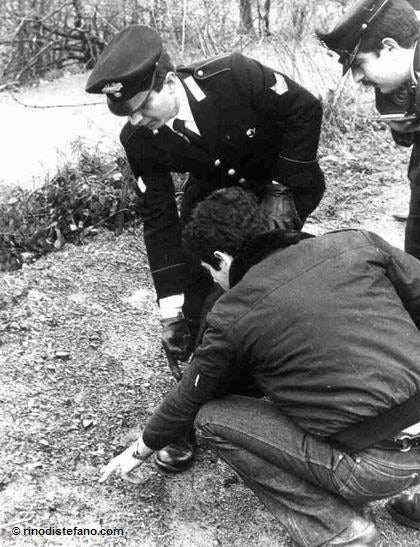
The day after the incident on the villa’s lawn, photographer Paolo Zeggio and writer Rino di Stefano observed:
‘We clearly noticed a semi-circular mark, very sharply defined, about 3 metres in diameter. The impression was about 15 centimetres deep and formed a very precise pattern, pressing the frozen grass down to a depth of about 3 centimetres.’
The Carabinieri themselves, in their report, describe this same brand as ‘the mark left by a helicopter or something large that had landed on the lawn’.
This was followed by a series of disappearances. During each one, he lost control of his vehicle and radio before being found by his colleagues. He claimed that these beings had taken him into space.

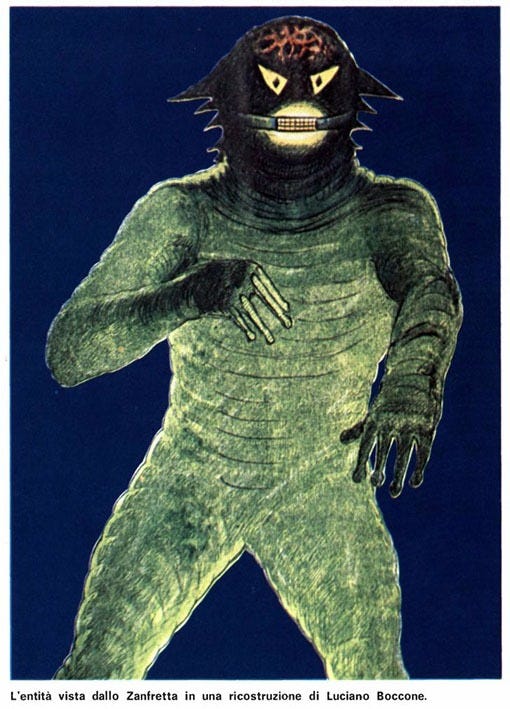
Later, during various sessions of regressive hypnosis (one of which was filmed and broadcast at the time, and is still available), he described beings that were three metres tall. They had “wrinkled green skin, triangular yellow eyes”, “no mouth, but a sort of grille” through which they communicated, and “red veins on the skull”. They were said to be called the Dargos.
Dr Moretti’s assessment
Following a hypnosis session conducted on Zanfretta in January 1979, Dr Mauro Moretti, the doctor who had performed the procedure and specialised in psychosomatic medicine, provided a recorded assessment. He stated that Zanfretta had reached an exceptionally deep level of trance, as evidenced by complete motor catalepsy, anaesthesia, and absolute eyelid immobility. Dr Moretti also noted that, during a previous session, he had deliberately attempted to introduce contradictions into Zanfretta’s account, but had not succeeded. His conclusion:
‘The possibility that he lied is negligible. Negligible indeed, I would say’
‘In my opinion, Zanfretta certainly did not feign anything. But the question remains, of course: if he did not feign anything, is the reality he described an objective reality or a subjective one?’
After taking all the sessions into account, he concluded that the probability of an objectively real experience was greater than that of a purely subjective reality. However, he also set a clear limit.
“The rest is not my area of expertise. I’m not a ufologist.”
However, two points are worth highlighting. Firstly, Moretti’s assertion that Zanfretta ‘could not lie’ under deep hypnosis is not supported by the scientific consensus — hypnosis does not reliably prevent deliberate deception or confabulation. Furthermore, his caveat regarding ‘objective reality vs subjective reality’ suggests that Zanfretta may have sincerely believed what he was describing, even if it did not actually happen. This method was subsequently abandoned in favour of cognitive interviews.
The Italian wave of 1978 — an exceptional context
1978 was a very special year for Italy from a ufological perspective. To gain insight into the context in which the Zanfretta case unfolded, we interviewed Edoardo Russo, a historian of the phenomenon and a founding member of the Italian Centre for Ufological Studies (CISU), one of the few European organisations to have conducted systematic, long-term cataloguing work. He knows many of the key figures involved in the Zanfretta case personally, and he coordinated the 2018 CISU conference, which focused entirely on that year.
Sentinel News : How significant was the “1978 wave” in Italy? Was the issue raised in Parliament?
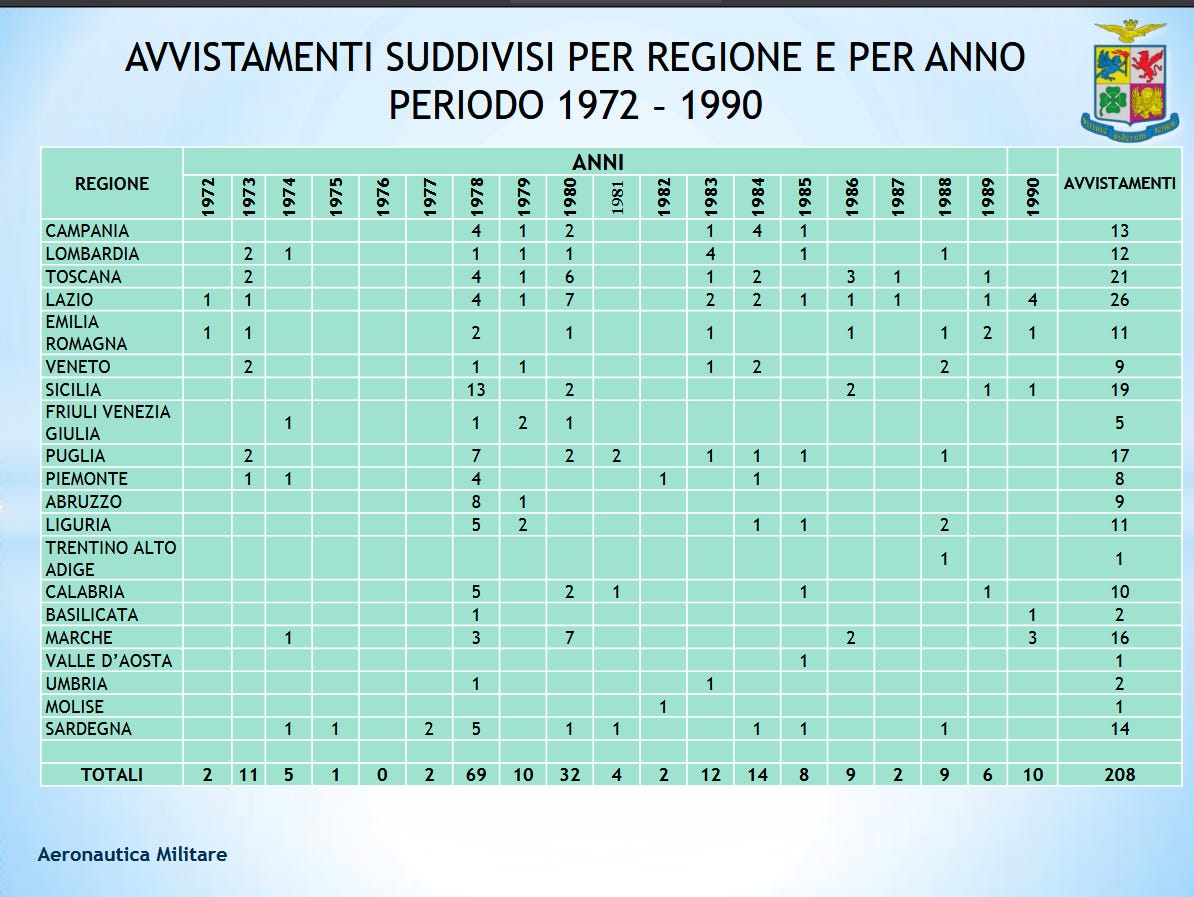
Edoardo Russo :The wave of sightings in 1978 was the largest ever recorded in Italy, even though it was part of a trend that began in 1977 and continued into 1979. It is difficult to summarize in a few words what this represented, both quantitatively and qualitatively. In addition to several peaks of activity observed as early as spring and summer, three “sub-waves” shook the media and public opinion: the mid-September wave that affected all of Italy, triggered by sightings of an atmospheric intrusion (never clearly identified); the November panic along the Adriatic coast (water columns, radar readings, objects entering and exiting the water, fishermen refusing to go out to sea out of fear, a significant drop in catches); the major nationwide invasion that spread throughout the month of December (and which ended abruptly after a spectacular wave of sightings and photos on New Year’s Eve). Beyond the media, the subject sparked interest in political circles: a parliamentary inquiry, military intervention, and then an official mandate given to the Air Force to collect reports.
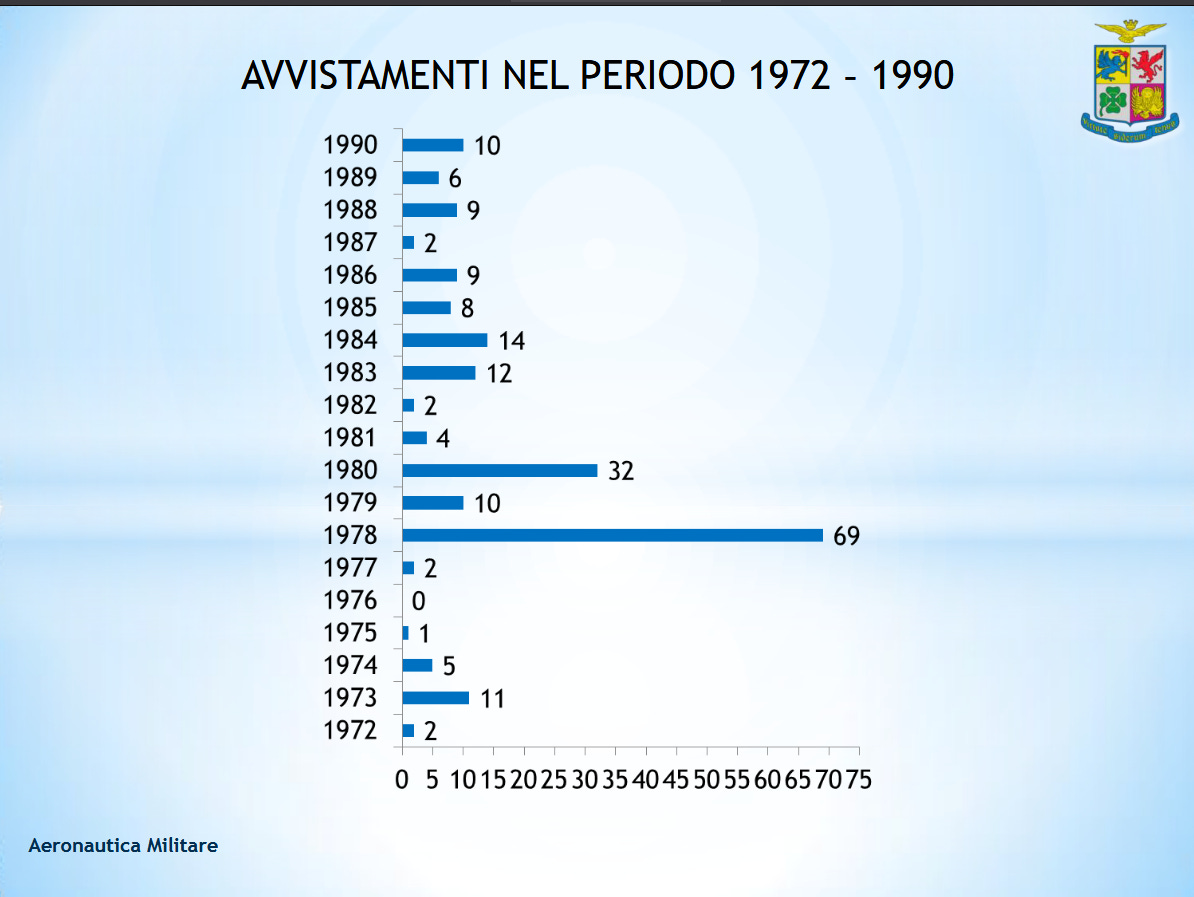
I have sent you some of the documents presented at the 2018 CISU conference, dedicated to that year. These include two sets of slides: my summary of the collected data(8); and a dual chronology of the ufological and sociological events of that year (compiled by Gian Paolo Grassino).
SN : During the inspection, when the footprint on the villa’s lawn was mentioned, it was described as a footprint in the flattened grass “shaped like a horseshoe, like a circle missing one side because there is a bump in the ground.” Does this mean that without this bump, it could have been round? And was there any reaction from the villa’s owners?
ER : These are two related questions: of course, the mark was circular, more precisely a ring; at our request, the villa’s owner wrote to us in a letter stating that there was nothing unusual about this mark, which was caused by his horse, tied to a post, pacing in circles and trampling the grass during the summer months.
What kind of UFO made Zanfretta suspicious when he saw the “UFO news” during the inspection?
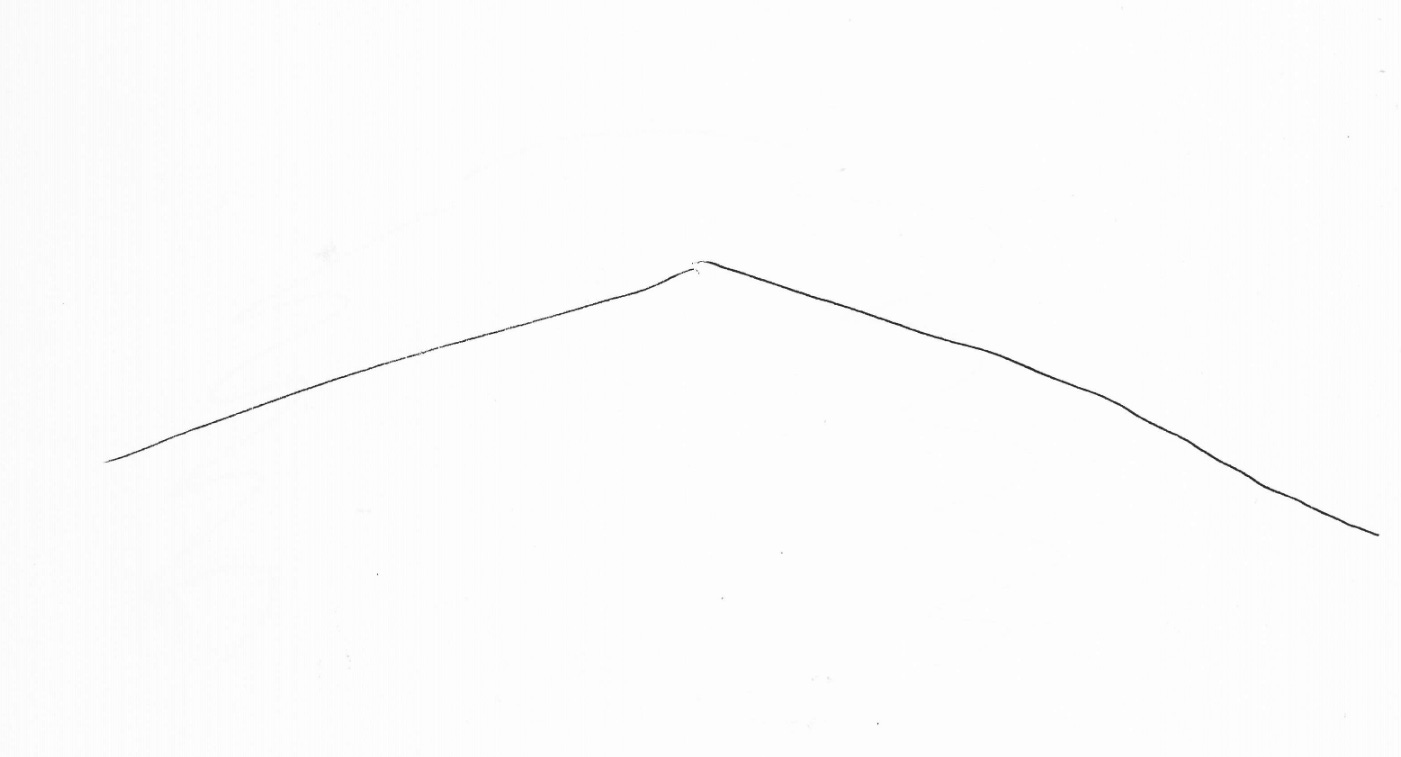
ER : Zanfretta drew me a sketch that I have forwarded to you. The object he saw rising into the sky was shaped like a Chinese hat (in cross-section: a triangle), luminous and yellow.
He drew it this way with his own hand.
What do you think of Jacques Vallée’s hypothesis that someone or something might be exploiting this phenomenon (“the result of an ‘induced’ experiment, a hoax like that of their alleged origin from the ‘third galaxy,’” according to L. Boccone’s conclusions) as a cover?
ER : What I thought at the time or what I think today about the various hypotheses of Jacques Vallée (with whom I have a long-standing friendship) is of no importance in this matter.
As for the case itself, which I followed closely during those eventful days of December 1978, I would highlight the following key points:
The young night watchman had a traumatic experience that night, involving something or someone he will no longer be able to identify with certainty, due to what happened afterward;
The role of ufologists (as well as certain journalists and the security firm for which he worked) significantly distorted and misrepresented his testimony, starting from the very first hypnosis session.
In Rino Di Stefano’s book (published six years later), the account of the events almost completely omits the role and actions of the various ufologists: there were at least five rival local groups competing with one another (CIRSUFO, CRVS, CUN, GRCU, GORU), each pulling in their own direction, thereby influencing the witness in various ways;
The first hypnosis session was conducted in a methodologically deplorable manner, based on a list of questions drafted by Luciano Boccone containing specific suggestions, referencing American cases, following a procedure that any expert in hypnotic regression would have resolutely avoided, so as not to influence the account;
It is no coincidence that the second abduction episode occurred four days after the hypnosis session (and just over 24 hours after the request for a second hypnosis session);
Since then, the situation has deteriorated, but not because of external manipulative interventions: the belief systems and incompetence of these ufologists (all of whom I knew personally and with whom I was friends at the time) were enough.
In 1978 alone, CISU recorded over 2,300 Italian reports, which accounted for 28% of all Italian reports collected up to that point.
According to the ufologist Richard Hall, more than 130 of these cases involved close encounters, with 25 of these involving humanoid entities. The phenomenon became so widespread that it was debated in the Italian Parliament.
Hall attributes this to a significant wave in Italy between October 1978 and January 1979, during which over 500 cases were recorded, including at least 130 close encounters and 25 involving humanoid entities, according to data provided by Edoardo Russo of the Centro Ufologico Nazionale (CUN).
However, the CISU cites 2,300 cases for the entire year, whereas Hall only cites 500 cases for the October–January period. These figures are not contradictory, but they measure different things.
Several dozen of these cases report encounters with humanoid entities, as well as unexplained power cuts, ground marks and states of shock similar to those described in the Zanfretta case.
It is precisely this type of account — repeated, consistent in structure and reported by witnesses with no apparent motive to lie — that has caught the attention of serious researchers. As early as the 1970s, French astronomer and computer scientist Jacques Vallée noted this pattern: from one country to another, the accounts converge, describing a power outage, a blinding light, paralysis, a medical examination, partial amnesia and physical traces on the ground. In Passport to Magonia (1969) and Confrontations (1990), Vallée rejects the simplistic extraterrestrial theory and the sceptical dismissal of the phenomenon on principle. Instead, he advocates a serious study of it. Harvard psychiatrist John Mack, a Pulitzer Prize winner, came to a similar conclusion after interviewing hundreds of witnesses. ‘These people are neither liars nor psychotics; their experiences deserve to be taken seriously,’ he wrote in Abduction (1994). This statement led to disciplinary proceedings against Mack by his university.
Nevertheless, we must remain in the realm of conjecture. These accounts could be psychological projections: the human mind is capable of fabricating experiences of striking coherence in certain dissociative states. They could also reflect cultural contamination: Close Encounters of the Third Kind was released in 1977, and the CISU notes that the Italian wave of 1978 followed the significant media attention surrounding Spielberg’s film and Hynek’s visit to Italy.
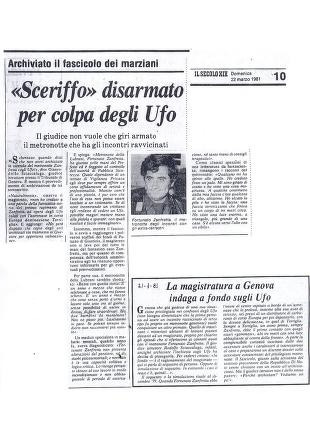
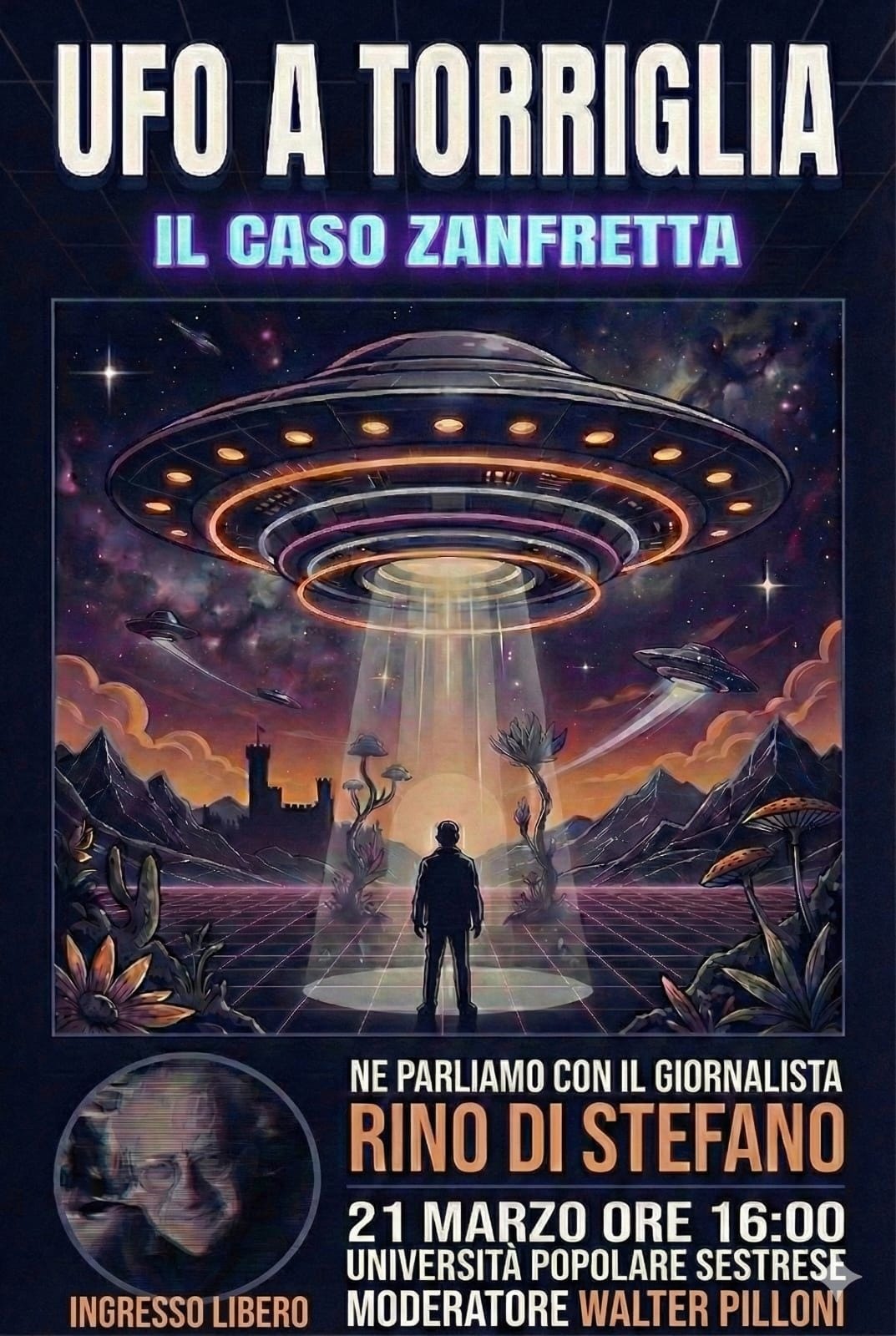
Today, nearly fifty years later, the “Zanfretta Case” remains one of the oldest mysteries in European ufology. On 21 March this year, author Rino di Stefano gave a lecture on the subject in Sestri, Italy, thus continuing to make this one of the oldest mysteries in European ufology.
We are caught between two impossibilities: proving it and refuting it completely.
Objective evidence exists and has been officially recorded. This includes the footprints on the ground documented by the Carabinieri and Captain Carusi’s telex2 classifying the facts as having a ‘buono’ degree of reliability, as well as the consistent testimonies of his colleagues. However, these documents do not prove an alien abduction. They prove that something happened and that, at the time, the Italian authorities deemed it serious enough to refer it to Parliament and the Air Force General Staff.
However, a document3 which remained confidential for decades and is absent from Di Stefano’s book now sheds the most sober and useful light on this case. On 25 April 1980, sixteen months after the initial incident, Gian Paolo Grassino, accompanied by Paolo Toselli and Corrado Malanga from the CUN in La Spezia, conducted a thorough “sopralluogo” at the Marzano di Torriglia site. Their report, finalised on 13 September 1980, reflects the attitude of researchers who believe in the phenomenon enough to travel to the site, take measurements, and compare the account with the terrain’s physical reality, yet nevertheless conclude that there is an accumulation of major inconsistencies.
The villa was not one of Val Bisagno’s clients. The ground between the gate and the villa is covered in walnut-sized gravel, making it impossible to cross silently in the dark. There is a physical obstacle in the form of a metal-reinforced concrete slab protruding from the wall, which is situated exactly where Zanfretta said he was ‘pushed from behind’, although no injuries were found. The marks on the ground, which supposedly prove a landing occurred, could be from a horse that regularly runs in a paddock. Grassino demonstrates using photographs taken in low-angle light that one can find ‘an infinite number of marks in the most varied shapes’ there. As for the three-metre-tall monstrous creature, it would coincide geometrically with a television aerial against a backdrop of fir trees as seen by a man in a semi-conscious state. Grassino does not conclude that this account is a lie. Instead, he suggests that there is a possible explanation: a man in a state of shock or severe hypertension, in total darkness and on unfamiliar ground, who mistakes ordinary objects for Martians and spacecraft. He adds, with a candour that stands in stark contrast to the rest of the literature on this case: ‘questa nostra mancanza di conoscenza non può permetterci di affermare “non è spiegabile — ergo è UFO”’ (“Our lack of knowledge does not allow us to assert: ‘It is inexplicable, therefore it is a UFO’”).
Finally, he highlights the central problem: Zanfretta is hostile towards ufologists, worn out from dozens of hypnosis sessions, interrogations, and endless ‘site visits’, whilst a group of interested parties has taken ownership of the case and refuses to question it.
That may well be the only reasonable conclusion. Zanfretta probably did not lie – Dr Moretti, the Carabinieri and his colleagues all agree on this. However, there is a wide spectrum between not lying and telling the objective truth, encompassing everything the human mind is capable of conjuring up in the dark under the influence of fear, as well as what years of repeated hypnosis, interrogations and ‘sopralluoghi’ can subsequently solidify into an unshakeable conviction. As Grassino soberly puts it, it is “un punto interrogativo che non si può certo definire un buon risultato” — a question mark that certainly cannot be considered a good result.
Il caso Zanfretta: La vera storia di un incredibile fatto di cronaca, Rino Di Stefano
Carusi’s telex, 8 December 1978, reproduced in Di Stefano’s book, pp. 192–193
Site Inspection Report — Marzano di Torriglia, 25 April 1980, Gian Paolo Grassino — final version 13 September 1980